
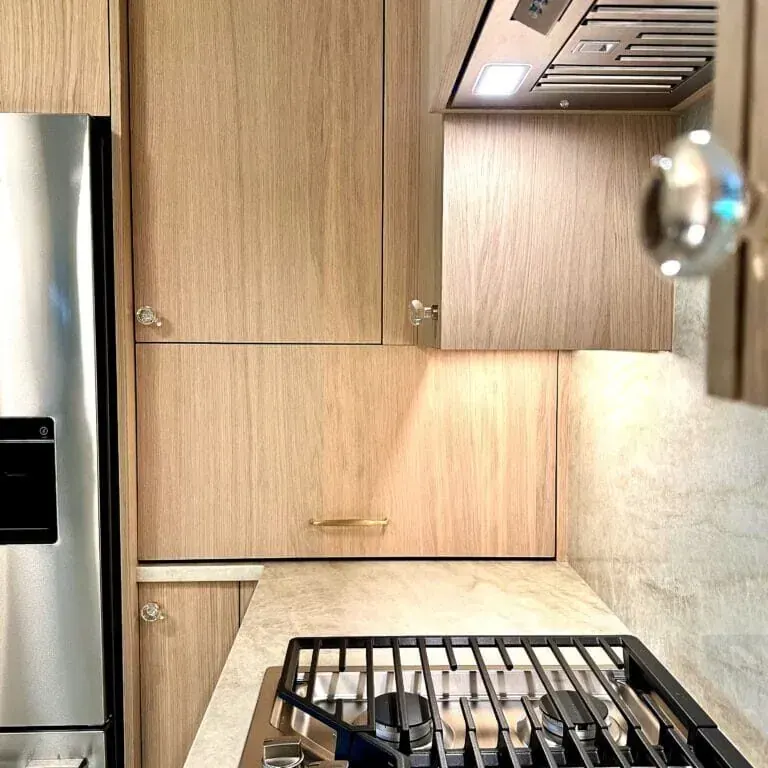
Plywood grades for cabinets describe how the face and back veneers look. They do not tell you how strong the panel is. Hardwood plywood is graded AA through E on the face and 1 through 4 on the back. Most cabinet boxes need nothing better than an A or B face.
This article covers what each grade means, which core to choose, and where each grade belongs in a cabinet. It is one part of our custom cabinet guide. If you are still choosing between wood and MDF for doors, read solid wood vs. MDF cabinets first. This page stays on plywood.
What do plywood grades mean for cabinets?
Plywood grades rate the appearance of the outer veneers. Under the ANSI/HPVA HP-1 standard for hardwood plywood, the face is graded AA, A, B, C, D or E, and the back is graded 1, 2, 3 or 4. A sheet labeled A-1 has a premium face and a clean back. The grade says nothing about the core.
Face grades limit what the veneer may show. That includes knots, patches, color streaks, mineral marks and splits. An AA face allows almost none of them. Each step down allows more of them, and larger ones.
Back grades follow the same logic with numbers. A 1 back is sound with few repairs. A 4 back may show open knotholes and splits, as long as the panel holds together.
Grades also look different by species. A B-grade maple face and a B-grade white oak face will not match in character. Ask to see a sheet from the actual lot before you commit.
Which plywood grade should you use for each cabinet part?
Match the grade to what people will see. Use an A face, or AA for clear stained work, on finished end panels and open shelving. Use B or C for interiors and painted parts. Save D grade for hidden parts like nailers and stretchers. One cabinet box often uses two or three grades.
| Grade | What the face allows | Typical cabinet use |
|---|---|---|
| AA | Very few natural marks; veneer matched for grain and color | Exposed stained panels, furniture-style end panels, open display shelves |
| A | Small, limited marks on a smooth, matched face | Finished end panels, visible box sides, stained interiors behind glass doors |
| B | Some color variation, small patches and pin knots | Cabinet interiors, painted end panels, shelves behind solid doors |
| C | Sound knots, more repairs and color streaks | Painted parts that get covered, utility and garage cabinets |
| D | Larger repaired defects and discoloration | Hidden parts: nailers, stretchers, backs set against a wall |
| Back 1 or 2 | Sound back with few defects | Panels where both sides show, such as shelves and partitions |
| Back 3 or 4 | Open defects allowed on the back | Faces fixed against a wall or another cabinet |
These pairings are a common convention, not part of the standard. The standard defines what each grade allows. It does not tell you where to use it.
Cabinet interiors are a judgment call. You see the inside of a cabinet every time you open the door. Many builders treat interiors as visible surfaces for that reason.
Do not pay for AA on a painted cabinet. Paint hides the grain you paid for.
What is the difference between veneer core, MDF core and combination core plywood?
Core type sets how the panel behaves. Veneer core is all wood plies, so it is lighter and holds screws well along its edges. MDF core is flatter and smoother but heavier, and it grips edge screws poorly. Combination core places thin MDF layers under the face veneers over a veneer center, for flatness at a lighter weight.
Veneer core is the traditional choice for cabinet boxes. It handles dado joints and screws well. Its weakness is flatness. Small voids or uneven plies can show through a thin face veneer.
MDF core gives the flattest, smoothest surface. That suits large flat panels and painted parts. It is heavy, and screws driven into its edges strip more easily.
Combination core splits the difference. You get a smoother face than veneer core, with less weight than MDF core. Many shops use it for boxes and panels.
Particleboard core also exists. It is the cheapest and heaviest option, and the weakest at fasteners.
For reference, Timber’s millwork division builds every cabinet box from 3/4-inch maple plywood. Its boxes use no particleboard substrate and no MDF back panels. Box panels are joined with dadoes, then glued and screwed. That is the box behind its custom cabinetry in the Hudson Valley.
Is Baltic birch plywood better for cabinets?
Baltic birch is not better in every case, but it is strong and stable. It uses thin birch plies throughout with few voids, so its edges look clean and hold screws well. It follows its own grading system, with grades like B, BB, CP and C, and it often comes in metric sheet sizes.
In that system, a B face is clear with no patches. BB allows color-matched patches. CP allows more patches and small knots. C allows open defects. A sheet labeled BB/CP has a BB face and a CP back.
Many builders use Baltic birch for drawer boxes and for cabinets with exposed plywood edges. The tight, even plies look intentional when left visible.
Check the sheet size before you plan your cuts. Baltic birch is often sold around 5 by 5 feet, not 4 by 8.
Is cabinet-grade plywood the same as construction plywood?
No. Construction plywood, such as CDX sheathing, is graded under a separate softwood standard, PS 1. Its letters describe softwood faces with different limits, and the X refers to its exposure-rated glue. It is made for walls and roofs, not cabinet boxes. “Cabinet grade” is a sales term, not a defined grade.
So when a supplier says cabinet grade, ask two questions. What are the face and back grades under HP-1? What is the core?
Those two answers tell you more than the label does.
What else should you check besides the grade?
Check the real thickness, the emissions label and whether the sheet is prefinished. Nominal 3/4-inch hardwood plywood often measures slightly thinner, which matters for dado joints. Look for TSCA Title VI or CARB Phase 2 compliance on the label. Prefinished sheets save finishing time, but glue bonds poorly to the coated face.
Measure each lot with calipers. Then cut your dadoes to the sheet, not to the number on the tag. A loose dado weakens the joint.
Edges need a plan too. Raw plywood edges show every ply. Most cabinet boxes get edge banding or solid wood edging. Timber’s shop finishes box edges with one of those two, matched to the door species.
Think about moisture last. Sink bases see leaks and wet sponges. Plywood boxes hold up better there than particleboard boxes do.
FAQ
What is the best plywood grade for kitchen cabinets?
For visible box parts, an A or B face with a 1 or 2 back covers most kitchens. Use AA only where clear stained wood will show. Hidden parts can drop to C or D grade.
What does A-1 plywood mean?
A-1 means an A-grade face and a 1-grade back under the HP-1 hardwood plywood standard. The face is smooth and matched, with few small marks. The back is sound with few repairs.
Can you paint B-grade plywood?
Yes. B-grade faces paint well, because paint hides color variation and small patches. Fill any open grain or patches first. Paying for A or AA under paint rarely makes sense.
What thickness of plywood is used for cabinet boxes?
Many builders use 3/4-inch plywood for sides, bottoms and shelves. Thinner plywood is common for backs. Thicker shelves resist sagging better over long spans.