
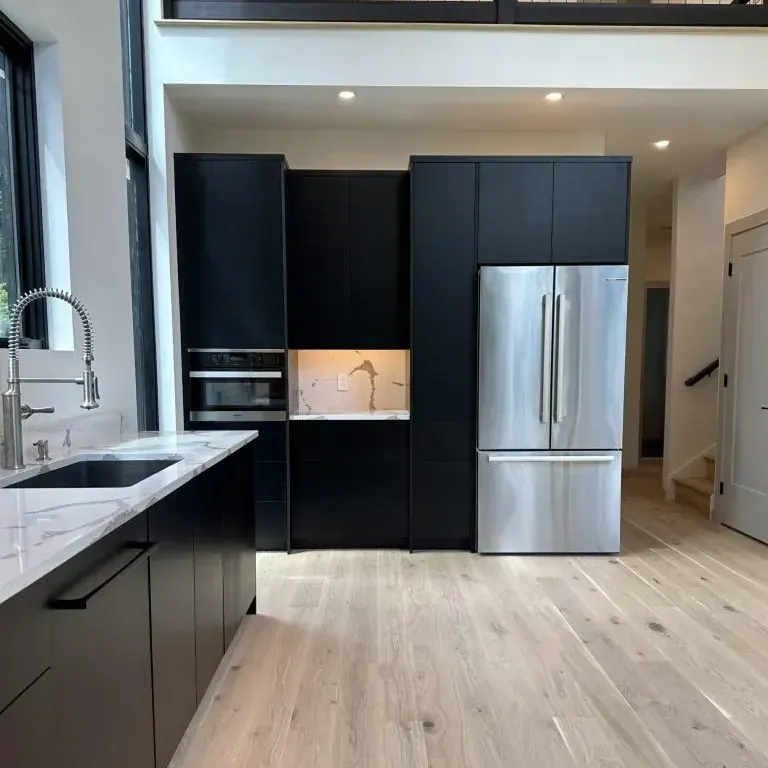
The right answer is both. Solid wood and MDF each belong in a well-built cabinet, just in different places — and the shops that build cabinets worth owning have been combining the two for decades.
This article is part of our custom cabinets guide.
Where a material sits inside the cabinet determines which one is correct. Solid wood handles structural load, holds fasteners, and belongs in face frames, drawer boxes, and door stiles and rails. MDF stays flat under paint and makes a better door panel for painted finishes. Swap those assignments and you pay for it — either in failing joints or in paint that cracks at the panel edges within a few years.
What Each Material Actually Is
Solid Wood
Solid wood is milled from a single piece of lumber. In our Marlboro shop, we reach for hard maple most often for stained face frames, and poplar for painted work. Poplar machines cleanly, takes primer without soaking it up unevenly, and costs less than maple or white oak. The grain in solid wood can telegraph through a painted finish if the surface is not properly sealed before topcoat, but that is a finishing process problem, not a reason to avoid the material.
MDF
Medium-density fiberboard (MDF) is made from wood fibers, wax, and resin pressed under heat and pressure into a dense, consistent sheet. No grain, no knots, no figure. It is flat and it stays flat, which is why paint sits on it so evenly. The trade-offs: MDF is heavy, does not hold screws reliably at its edges, and fails fast when it gets wet. A solid wood cabinet frame that absorbs moisture will swell and dry. An MDF box that gets wet can delaminate and stay that way.
Where Solid Wood Belongs in a Cabinet
Face frames — the front border you see on a face-frame cabinet — are almost always solid wood because they receive hinges, door catches, and daily hand contact. Solid wood compresses around a fastener. MDF strips out near an edge and does not recover.
Drawer boxes are built from solid wood for the same reason. The dovetail joints that hold a drawer box together need wood fiber that grips and resists racking under load. We run our drawer boxes in hard maple at 1/2-inch thickness. For stained finishes, door panels are solid wood as well. You cannot stain MDF and get a result worth showing anyone — it absorbs unevenly and has no figure to speak of.
Door stiles and rails — the outer frame of a raised-panel or flat-panel cabinet door — are solid wood in every custom cabinet we build. They carry the hinge load and absorb mechanical stress each time the door swings. That is not a job for a sheet material.
For the cabinet box itself, many custom shops move to hardwood plywood rather than solid wood. Plywood holds screws better than MDF, moves less than solid wood, and comes in at a manageable weight. We cover box material decisions in our complete guide to custom cabinets.
Where MDF Makes More Sense
Painted cabinet doors. That is the short answer.
When a customer wants a flat-panel or raised-panel door in a painted finish, MDF door panels stay flatter than solid wood panels and accept primer and topcoat without showing grain. The paint job lasts longer because there is less wood movement working against the finish coat from behind.
A solid wood panel inside a door frame is designed to float. It is not glued — the panel sits in a groove so it can expand and contract seasonally without splitting the stile. In a painted finish, that movement eventually cracks the paint at the panel edges. MDF panels move very little, so the paint holds longer. If you have ever seen a painted cabinet door with hairline cracks running along the panel edges, that is typically a solid wood panel that was not given room to move, or was glued in place by a shop cutting corners.
MDF also works well for decorative applied molding on painted cabinet doors, and for furniture-grade millwork pieces that will be painted and will not be near a water source. For more on how painted finishes perform on cabinets over time, see our article on painted vs. stained cabinets.
Solid Wood vs. MDF: Side by Side
| Feature | Solid Wood | MDF | Timber’s Take |
|---|---|---|---|
| Durability | High — resists denting, holds fasteners, can be resanded and refinished | Moderate — flat and stable in dry conditions; delaminate and fails under moisture | Solid wood for anything structural or near a water source |
| Cost range | Higher — varies by species; walnut and white oak cost more than poplar or maple | Lower — consistent cost, no species-based price variation | Usually between MDF and solid wood; varies by grade and face veneer |
| Best for painted finish | Acceptable — poplar paints well; grain can show through without proper sealing | Excellent — no grain telegraphing, flat surface accepts primer cleanly | MDF for door panels; solid wood for stiles, rails, and face frames |
| Best for stained finish | Excellent — grain and figure show correctly; accepts stain and clear coat | Not suitable — no grain to stain, absorbs finish unevenly | Solid wood only on any stained cabinet work |
| Moisture resistance | Good — swells with exposure but can dry and often be salvaged | Poor — swells and delaminates when wet; difficult to repair | Avoid MDF near sinks, dishwashers, and exterior walls |
| Screw-holding | Excellent — especially in face-grain and long-grain | Fair in face — strips out near edges where fasteners pull through | Solid wood or plywood for all structural connections |
| Weight | Moderate — varies by species; poplar lighter than walnut | Heavy — denser than most cabinet-grade solid wood at the same thickness | Account for MDF weight when planning upper wall boxes |
| Repairability | High — can be sanded, patched, refinished in place | Low — surface damage is difficult to repair cleanly and invisibly | Solid wood is the better long-term investment for visible surfaces |
How We Actually Build It in Our Shop
In our Marlboro shop, a custom painted kitchen cabinet typically comes together like this: ¾-inch maple plywood box, solid poplar face frame, solid wood door stiles and rails, MDF center panel on the door. For a stained kitchen in white oak or cherry, the door panel goes to solid wood as well, and we mill the face frame from the same species so the grain reads consistently across the whole cabinet run.
That is not a workaround. It is how each material performs best. Plywood and solid wood carry the structural load. MDF handles the flat painted surface. Neither material is doing a job it was not built for.
What we will not do is build an all-MDF box for a kitchen. We have seen those in renovation tear-outs. The base cabinets swell at the bottom from one significant leak, and the whole run needs to come out. A plywood or solid wood box in the same situation dries out and can often be salvaged. That difference matters to a homeowner fifteen years in.
If you are looking at cabinets and trying to figure out what is actually inside the box, our guide on how to tell if cabinets are well built covers exactly what to look for and what to ask.
Frequently Asked Questions
Is solid wood or MDF better for kitchen cabinets?
Neither is universally better. The right choice depends on where the material is used inside the cabinet. Solid wood belongs in structural components: face frames, door stiles and rails, and drawer boxes. MDF performs better as the panel in a painted door because it is dimensionally stable and does not telegraph grain through the finish coat. Quality custom cabinets use both materials, each in the role it handles best.
Do MDF cabinets hold up long-term?
MDF holds up well in low-moisture environments when used correctly, typically as door panels or interior components in a painted finish, not as the primary box material in a kitchen. The failure mode for MDF is moisture: one significant water event under a sink can swell an MDF cabinet box beyond repair. Plywood and solid wood boxes are more forgiving in the same situation and more likely to be salvageable.
Why do some shops use MDF for painted cabinet doors?
Because MDF takes paint better than solid wood for door panels. It has no grain to sand through or seal, stays flat so the paint film does not crack at the panel edges, and mills a clean profile for raised-panel door styles. The door stiles and rails are still solid wood — MDF only makes sense for the floating center panel, where dimensional stability matters most for a painted finish.
Can MDF cabinets get wet?
Not without risk of lasting damage. MDF swells when it absorbs water, and once the internal wood fibers separate, the material does not return to its original dimensions or structural integrity. Under sinks and near dishwashers, plywood or solid wood box construction is the right call. If a shop is specifying an MDF cabinet box for a kitchen, get a clear explanation of why before you approve the build.
How Timber Can Help
When my team builds a kitchen in our Marlboro shop, the material decision — solid wood vs. MDF vs. plywood — happens at the design stage, before a single board is cut. Amanda Barton draws every project in Chief Architect 3D so the customer sees the species, finish, and door style in context before we build anything. The same team that draws it builds it and installs it.
If you are planning a kitchen remodel or custom millwork project, here is where to start:
- Custom Millwork — cabinets, built-ins, and custom woodwork built in our Marlboro shop
- Kitchen Remodel — full kitchen design and build, $75,000–$200,000
- Bathroom Remodel — vanities, tile, and custom millwork
- Whole-House Renovation — full scope from demo to finish
- Design-Build — one team from concept through construction
- Home Addition — expansions designed and built in-house
- Custom Home Builder — ground-up custom homes
- Preconstruction — budgeting, planning, and scope development before breaking ground
Serving Marlboro, New Paltz, Wallkill, and the Hudson Valley. Talk to Our Team
Jeff Wiegmann is a Licensed General Contractor and Co-Founder of Timber Design + Build. Our team designs, builds, and installs custom millwork from our Marlboro shop at 168 Mt. Zion Road. We’ve matched 19th-century profiles for historic homes and built kitchens from $75k to $200k — always with the same crew from design to install.