
By Jeff Wiegmann, Licensed General Contractor & Co-Founder, Timber Design + Build
This article is part of our custom cabinets guide. For cabinetry built for your home, see custom cabinetry and millwork in the Hudson Valley.
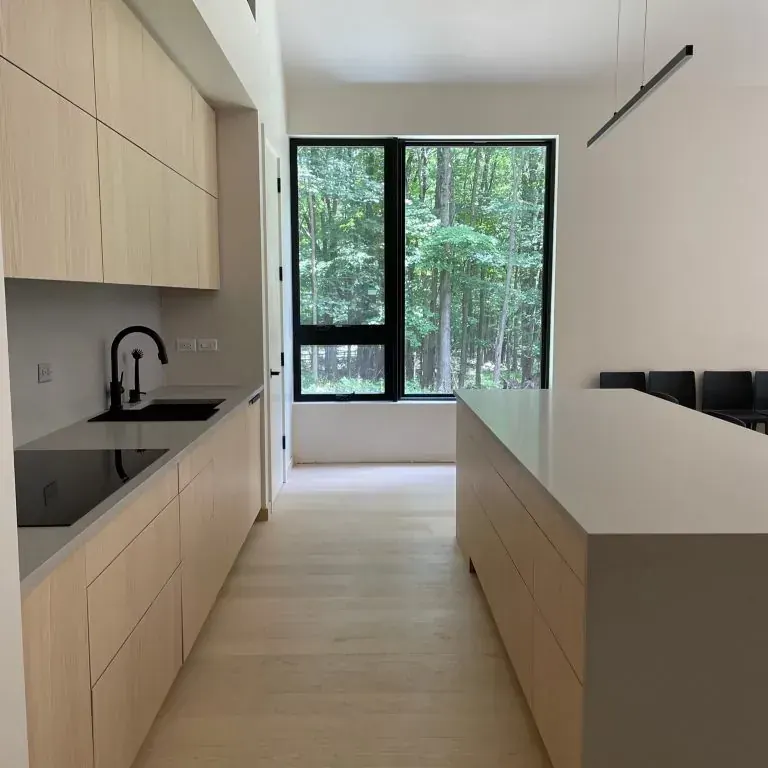
White oak holds grain, maple holds paint, and cherry holds patina. Which one belongs in your kitchen comes down to one thing: how you plan to finish them.
In our Marlboro shop, we mill all three regularly, and each species has a personality that shows up in fabrication before we ever apply a finish coat. Understanding those differences saves homeowners from choosing a species based on a photo and regretting it at install. If you’re still working through the fundamentals of hardwood cabinet construction, our custom cabinets guide covers how species fits into the full build decision.
How Species Affects Grain, Hardness, and Finish
Species selection affects four things: grain pattern, hardness, how the wood absorbs finish, and how it ages. The first two are visible and measurable on day one. The last two are the ones that produce surprises three to five years after installation when a homeowner didn’t know what they were agreeing to.
Grain pattern is a visual decision. Hardness determines dent and scratch resistance over years of real kitchen use. Finish behavior determines whether staining, painting, or a clear coat is the right direction. Aging covers long-term color shift, and some species shift dramatically. All three species in this comparison are solid hardwood — the choice between solid wood and an engineered substrate is a separate decision that comes before this one.
White Oak: Open Grain That Carries the Design
White oak has a Janka hardness of 1,290 lbf, which is more than adequate for kitchen use. Its open grain reads as visible texture on a finished cabinet face, and that texture is what’s driving most of the design interest in the species right now.
How you cut white oak changes how it looks. Rift-sawn white oak produces a tight, consistent linear grain with minimal figure across the face. Quarter-sawn white oak exposes the medullary rays, producing the distinctive ray fleck pattern that has been widely specified in contemporary and transitional kitchens for the past several years. In our shop, rift-sawn is the more common call because the clean, consistent face reads well across a full run of doors without any single panel pulling focus.
White oak accepts stain evenly. Water-based and oil-based products both absorb without blotching, which gives us flexibility across a wide range of tones. It also accepts ceruse finishes well, where the open grain is wire-brushed and filled with a light compound to accentuate the texture. What white oak does not handle well is paint. Open grain can telegraph through painted finishes over time, and clients who want a clean, smooth painted face are better served by maple.
White oak sits in the mid-to-upper range of domestic hardwood pricing. Ask Timber for current material pricing in your project scope.
Maple: The Right Substrate for a Painted Finish
Hard maple reaches 1,450 lbf on the Janka scale, making it the hardest species in this comparison. Its grain is tight and closed, with almost no visible pore structure, which produces a face that is essentially smooth from the mill.
That smoothness is exactly why maple is the species we specify for painted cabinets. There is no open grain to telegraph through the finish, no pore to fill before painting, and alkyd or catalyzed lacquer lays down flat over a properly prepared maple substrate. A maple face frame and door under a quality topcoat produces as clean a finished surface as you’ll get from solid hardwood. For a deeper look at how finish direction and species selection interact, our painted vs. stained cabinets article covers the full decision.
The trade-off is staining. Maple absorbs pigmented stain unevenly, a condition called blotching, which produces a splotchy, inconsistent result across the face. Pre-conditioners and gel stains reduce the effect but don’t eliminate it. When a client comes to us wanting a dark stained maple kitchen, we have that conversation directly. If a stained look is what they’re after, white oak is the easier, more predictable material to work with.
Maple tends to run at the lower end of the three species on material cost. Ask Timber for current pricing on your project.
Cherry: The Species That Changes After You Install It
Cherry comes in at around 950 lbf on the Janka scale, noticeably softer than maple and white oak. In a high-traffic kitchen, that difference is real: cherry dents more readily under daily impact. That’s a trade-off worth stating plainly before a client commits.
What makes cherry worth the conversation is patina. Cherry is photosensitive and deepens in color with UV exposure over time, shifting from a pale pinkish-tan when freshly milled to a warm, rich reddish-brown over years. That shift is permanent and it is the defining characteristic of the species. A client who isn’t expecting it and opens their kitchen a decade in to find the color has transformed is not a pleasant situation. In our shop, every client who chooses cherry gets a photo of aged cherry before the order goes in.
Cherry accepts a clear or lightly tinted oil finish well, and that is usually the right call. Letting the patina develop without obscuring it is the reason people love old cherry kitchens. For traditional, craftsman, or historically detailed homes, cherry is often the most appropriate species on this list. In our Marlboro shop, we’ve used it on several projects in older Hudson Valley homes where the warmth reads naturally against period trim and millwork.
Cherry typically runs at the upper end of domestic hardwood pricing. Ask Timber for current material costs.
White Oak vs. Maple vs. Cherry: Side by Side
| Feature | White Oak | Maple | Cherry | Timber’s Take |
|---|---|---|---|---|
| Grain pattern | Open, pronounced; ray fleck visible on quarter-sawn | Tight and closed, near-invisible pore structure | Fine to medium, subtle figure | Grain visibility is a design decision, not a quality indicator |
| Janka hardness | 1,290 lbf | 1,450 lbf | 950 lbf | Maple wins on hardness; cherry requires real consideration in high-use kitchens |
| Takes stain | Yes, evenly | Prone to blotching without conditioning | Yes, evenly; clear finish usually the better call | Stained look: use white oak. Painted look: use maple |
| Best finish type | Natural oil, water-based stain, ceruse | Paint, clear coat, light stain with pre-conditioner | Clear oil, light tint | Match the finish to the species, not the other way around |
| Ages and shifts color | Mellows slightly, stable overall | May yellow slightly over time | Darkens significantly to rich reddish-brown | Cherry buyers need to understand and accept the patina before committing |
| Best cabinet style | Contemporary, transitional, Shaker | Painted Shaker, inset, flat-front | Traditional, craftsman, raised panel | Style associations are guidelines, not rules |
| Relative cost | Mid to upper | Lower to mid | Upper | Quoted per project |
Which Species We Reach for Most at Timber
White oak is our most-requested species by a significant margin right now. The demand has been building for years and hasn’t let up. Clients renovating or building contemporary and transitional kitchens almost universally land on it, and the rift-sawn cut in particular has become a standard specification in our shop. When someone walks in without a species preference and wants a natural-finish kitchen, white oak is where the conversation almost always starts.
Maple is our default recommendation the moment a client commits to painted cabinets. It’s also the right call when solid hardwood performance is the goal and material cost is a real constraint. For what a painted finish demands from a substrate, maple is the clear answer.
Cherry is a conversation before it becomes a commitment. When it fits the project, there’s nothing else that produces the same result. We’ve built cherry kitchens for older homes in the Hudson Valley where the warmth and patina are exactly what the house needed. But we don’t put a client in cherry without making sure they understand what they’re agreeing to.
For a broader look at hardwood species options beyond these three and how species interacts with construction method and joinery, our best wood for kitchen cabinets guide covers the full material decision.
Frequently Asked Questions
Is white oak or maple better for kitchen cabinets?
It depends on the finish. White oak is the better species for stained or natural finishes because its open grain accepts color evenly and the texture reads as an intentional design element. Maple is the better choice for painted cabinets because its tight, closed grain produces a smoother painted surface without grain telegraphing through the finish over time.
Do cherry cabinets darken over time?
Yes, significantly. Cherry is photosensitive and shifts from a pale pinkish-tan when freshly milled to a rich reddish-brown over years of light exposure. The shift is permanent and is considered the defining aesthetic characteristic of the species. Anyone choosing cherry should look at photos of aged cherry before finalizing the decision.
Why is maple hard to stain?
Maple’s tight grain structure absorbs pigmented stain unevenly, producing a blotchy, inconsistent result across the face. The pores are small enough that stain doesn’t penetrate uniformly. Pre-conditioners and gel stains reduce blotching but don’t eliminate it entirely. If a stained finish is the goal, white oak is a more predictable and consistent species to work with.
What is the hardest wood commonly used for kitchen cabinets?
Among these three species, hard maple is the hardest at 1,450 lbf on the Janka scale, outperforming white oak at 1,290 lbf and cherry at 950 lbf for dent and scratch resistance. For kitchens that see heavy daily use, maple’s hardness is a real functional advantage.
Does white oak need to be quarter-sawn for cabinets?
No. White oak can be rift-sawn, quarter-sawn, or flat-sawn depending on the grain pattern the design calls for. Rift-sawn gives a consistent linear grain, quarter-sawn shows the ray fleck, and flat-sawn produces a more pronounced cathedral pattern. The cut is an aesthetic decision, not a structural requirement.
How Timber Can Help
In our Marlboro shop, we work through species selection before anything is ordered. Amanda Barton models the cabinet design in Chief Architect 3D and we review it against a real material sample before fabrication starts. That process stops the regret that comes from choosing a species from a website photo rather than seeing it under your kitchen’s actual lighting conditions.
Our team designs, builds, and installs. The same people who discuss species with you at the design table are the ones milling the parts, applying the finish, and hanging the doors at installation. That continuity matters when a design-phase decision has to be executed correctly at every stage of the build.
- Custom Millwork — species selection, milling, finishing, and installation
- Kitchen Remodel — full scope from design through install, $75,000–$200,000
Serving Marlboro, New Paltz, Wallkill, and the Hudson Valley. Talk to Our Team About Custom Cabinets
Jeff Wiegmann is a Licensed General Contractor and Co-Founder of Timber Design + Build. Our team designs, builds, and installs custom millwork from our Marlboro shop at 168 Mt. Zion Road. We’ve matched 19th-century profiles for historic homes and built kitchens from $75k to $200k — always with the same crew from design to install.