
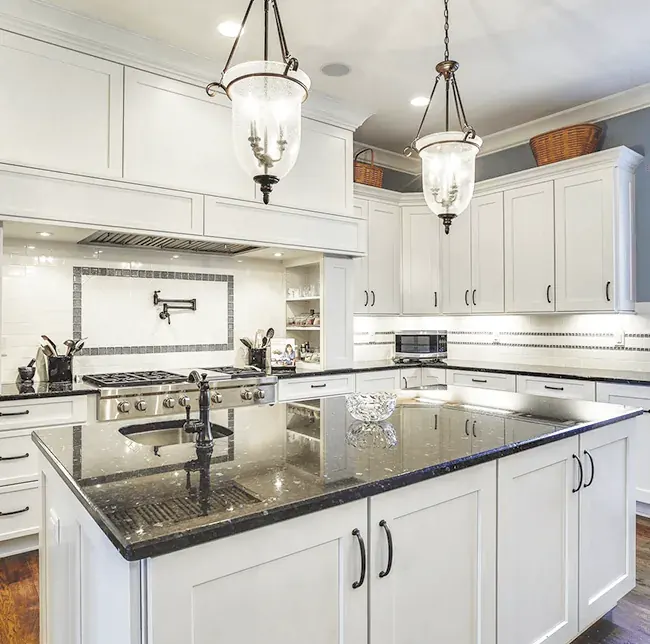
The main types of crown molding are cove, ogee (or cyma), dentil, egg-and-dart and built-up crown. Each profile suits a different style of room. The right one also has to fit your ceiling height. A crown that is too large makes a low room feel lower.
Crown molding is one form of custom millwork. This guide covers profiles, sizing, materials, installation and matching crown in older houses. For cabinets, see our guide to crown molding for kitchen cabinets.
What is crown molding?
Crown molding is trim that covers the joint where a wall meets the ceiling. Most crown is sprung, which means it sits at an angle with a hollow space behind it. It hides the uneven line where two surfaces meet. It also adds shadow and a finished edge to the room.
Crown is the top member of a cornice. On classical buildings, the cornice is the projecting band at the top of a wall. Crown molding brings a version of it indoors.
Crown also appears on cabinets, bookcases, door heads and mantels. The profile names below apply to all of them.
What are the main types of crown molding profiles?
The common crown profiles are cove, ogee, dentil, egg-and-dart and built-up. A cove is a simple concave curve. An ogee is an S-shaped curve. Dentil adds a row of small square blocks. Egg-and-dart adds a carved band of ovals and points. Built-up crown stacks several moldings into one larger profile.
- Cove. A single concave curve. It is plain and quiet. It suits modern, Shaker and simple traditional rooms.
- Ogee or cyma. An S-curve that joins a concave and a convex arc. Cyma recta puts the concave curve on top. Cyma reversa flips it. This is the classic traditional crown shape.
- Dentil. A band of small, evenly spaced blocks, set under a cove or ogee. The spacing has to work out at each corner, so layout takes care.
- Egg-and-dart. A repeating carved pattern of egg shapes and arrow-like darts. It reads as formal and classical.
- Built-up. Several pieces combined, such as a frieze board, a bed molding and a crown. It allows a bigger, more detailed cornice than any single stock piece.
Pick the profile from the house, not the catalog. A Greek Revival parlor and a plain Craftsman bungalow need different crowns. Look at the casing and baseboard first. The crown should belong to the same family.
What size crown molding should you use?
Size crown to the ceiling height. A common rule of thumb is 3 to 5 inches of crown for an 8-foot ceiling. Nine-foot ceilings can take about 5 to 7 inches. Ten feet and up can carry 7 inches or more, often as built-up crown. Room size and the other trim matter too.
Two measurements describe a sprung crown. Its height is how far it drops down the wall. Its projection is how far it reaches onto the ceiling. A crown with a deep projection looks heavier than its height suggests.
Match the crown to the baseboard and casing. A tall crown over thin casing looks top-heavy. Keep crown and baseboard in a similar scale so the room reads as one set.
Do not size crown from a sample in a store. Hold a short length up in the room itself. Look at it from the far wall.
What is the difference between sprung and flat-installed crown?
Sprung crown is installed at an angle, bridging the wall and ceiling with a hollow triangle behind it. Common spring angles are 38 and 45 degrees. Flat-installed pieces lie tight against the wall or the ceiling. Many large cornices combine both: flat boards on each surface, joined by a smaller sprung crown.
Spring angle matters when you cut. A 38-degree crown and a 45-degree crown need different saw settings. Check the angle before you set up the saw. Do not mix spring angles in one room, because the corners will not meet.
Sprung crown can be cut two ways. You can nest it upside down against the saw fence at its installed angle. Or you can lay it flat and set both the miter and the bevel on a compound saw.
Backing helps. A continuous nailer or blocking behind the crown gives solid fastening between studs and joists. It matters most for large and built-up crown.
What is crown molding made of?
Crown molding is made from solid wood, finger-jointed pine, MDF or polyurethane. Stain-grade crown needs solid hardwood. Poplar is a common paint-grade choice. MDF is stable and smooth to paint but swells when wet. Polyurethane is light and resists moisture. Flexible versions bend around curved walls.
| Material | Finish | Strengths | Watch for | Good fit |
|---|---|---|---|---|
| Solid hardwood | Stain or clear | Real grain; can be milled to any profile | Grain must match piece to piece; moves with humidity | Stained rooms and libraries |
| Poplar | Paint | Holds nails; takes paint well; dents less than MDF | Costs more than MDF | Painted traditional rooms |
| Finger-jointed pine | Paint | Long, straight lengths | Joints can show through thin paint | Long painted runs |
| MDF | Paint | Smooth and consistent | Swells if wet; heavy; edges crush | Dry rooms with painted trim |
| Polyurethane | Paint | Light; resists moisture; flexible versions bend | Does not take a true wood stain | Bathrooms, curved walls, ornate profiles |
Stain-grade crown takes the most planning. Boards are chosen for grain and color, and every joint shows under a clear finish. White oak, red oak, cherry, black walnut and hard maple all take stain.
Polyurethane crown is mitered and glued at every corner, not coped. Follow the maker’s instructions for adhesive and fasteners.
Should inside corners of crown molding be coped or mitered?
Cope inside corners and miter outside corners. A coped joint runs one piece square into the corner. The next piece is cut to the profile so it fits over the first. Coped joints hide out-of-square walls and stay tighter as wood moves. Mitered inside corners open up with the seasons.
Coping takes more skill. The second piece is first cut with an inside miter to reveal the profile. The waste is then removed with a coping saw, back-cut slightly and filed to fit.
Outside corners are mitered and glued. A little glue in the miter keeps it from opening later.
Out-of-square corners are normal in older houses. Timber’s custom millwork page notes that walls out of parallel and floors out of level are normal in Hudson Valley homes built before 1990. Coped joints and careful scribing absorb those errors. A mitered inside corner shows every one.
How do you match crown molding in an older house?
To match old crown, record the existing profile exactly. Remove a short piece from a closet or other hidden spot, or trace it with a profile gauge. A millwork shop can then grind knives to reproduce it. Stock profiles rarely match historic trim, so do not assume a store piece will blend in.
Strip a small section before you trace it. Decades of paint fill in the fine details of a profile.
Check whether the old crown is one piece or several. Many older cornices are built up from smaller moldings, so each part needs its own match. Some are run plaster, not wood. That is a plaster job, not a millwork one.
Timber’s shop has matched molding profiles in Hudson Valley homes built from the 1840s through the 1920s. Timber Design + Build runs a millwork and cabinet shop in Marlboro, NY. Its team measures the actual room in the field, and its own carpenters handle installation. Cost depends on size, material, profile and finish. Read more about its custom millwork in the Hudson Valley.
FAQ
What is the most common type of crown molding?
In traditional American houses, ogee or cyma profiles are the most familiar. Simple cove crown is common in plainer and modern rooms. The right choice depends on the style of the house. Pick the profile that suits the casing and baseboard already in the room.
Can you put crown molding on an 8-foot ceiling?
Yes. Choose a smaller profile, in the 3 to 5 inch range under the common rule of thumb. A simple cove or small ogee keeps the room from feeling lower. Painting the crown the ceiling color also softens it.
Is crown molding the same as cornice molding?
Not quite. A cornice is the whole projecting assembly at the top of a wall. Crown is the top piece of that assembly, and often the only piece in a house. A built-up cornice combines crown with bed molding, frieze boards or dentils.
Should crown molding match the walls or the ceiling?
Either can work. Painting crown the ceiling color makes the ceiling feel larger. Painting it the trim color ties it to the casing and baseboard. A contrasting color draws the most attention to the profile.