
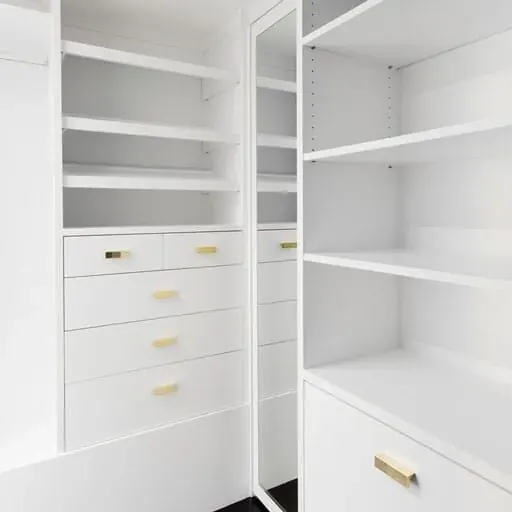
Custom millwork is woodwork made for one specific house: cabinets, built-ins, paneling, mantels and moldings built to that room’s real measurements. It is not ordered from a catalog. If a piece comes in fixed sizes and needs filler strips to fit, it is stock millwork, not custom.
This guide explains what custom millwork includes and how it differs from trim and stock products. It also covers the woods used and how a piece moves from drawing to installation.
What is custom millwork?
Custom millwork is any shaped wood element designed and produced for a particular space. That includes cabinetry, built-in shelving, wall paneling, fireplace surrounds, ceiling beams and moldings. Each piece is drawn to the room’s actual dimensions, made in a shop, finished, and then installed. “Custom” means the size, profile and wood are chosen for that project.
The word comes from the mill. Lumber mills once cut and shaped wood into doors, windows, moldings and other finished parts. Today the term covers interior wood products shaped in a shop rather than built from raw boards on site.
The trade splits millwork into two broad groups. Architectural millwork is the fixed woodwork of a room, such as moldings, paneling, stair parts and mantels. Casework means box-built pieces, such as cabinets, vanities and bookcases. Many custom shops make both.
Custom is one end of a range. At the other end are stock parts sold by the foot or in standard sizes. You can mix the two in one house. A stock baseboard can sit below a custom library wall without trouble.
What is the difference between millwork and trim?
Trim is one kind of millwork. Trim means the moldings that finish edges and cover joints, such as baseboard, door casing, window casing and crown molding. Millwork is the wider category. It also includes cabinets, built-ins, paneling, mantels, doors and stair parts. All trim is millwork, but most millwork is not trim.
People use the two words loosely. A builder may say “trim package” and mean every interior molding in the house. Another may say “millwork” and mean only the cabinets.
Finish carpentry is a third term. It names the trade that installs trim and millwork on site. Millwork is the product. Finish carpentry is the installation.
Do not assume two quotes cover the same work because they use the same word. Ask each bidder to list every item included, room by room.
What are the main types of millwork in a home?
The main types are moldings, wall paneling, built-in storage, cabinetry, fireplace mantels and ceiling treatments. Moldings and paneling dress walls and openings. Cabinetry and built-ins add storage. Mantels and coffered ceilings create a focal point. Most houses use several types, and they read as one design when they share profiles and a finish.
The table below shows where each type is used and what it is usually made from.
| Type | What it includes | Where it is used | Common materials |
|---|---|---|---|
| Crown molding | Molding where the wall meets the ceiling | Living rooms, dining rooms, kitchens, tops of cabinets | Poplar, pine, MDF, oak |
| Baseboard and casing | Molding at the floor and around doors and windows | Every room | Poplar, pine, MDF, oak |
| Wainscoting | Paneling on the lower part of a wall, capped by a rail | Dining rooms, halls, stairways, bathrooms | Poplar, MDF, plywood panels, oak |
| Built-ins | Bookcases, window seats, desks and benches fixed to the wall | Living rooms, offices, entries, alcoves | Plywood boxes with hardwood face frames |
| Cabinetry | Kitchen cabinets, vanities, pantry units | Kitchens, bathrooms, laundry rooms | Plywood boxes, hardwood or painted doors |
| Fireplace mantels | A shelf and surround that frame the firebox | Living rooms, family rooms, bedrooms | Oak, walnut, cherry, poplar for paint |
| Coffered ceilings | A grid of beams that forms recessed panels | Dining rooms, libraries, great rooms | MDF, poplar, oak |
Each row is a separate decision. You do not need all of them. One well-placed built-in often does more for a room than new trim everywhere.
How is custom millwork different from stock millwork?
Stock millwork comes in fixed sizes and profiles chosen by a manufacturer. Installers adapt it to the room with fillers, scribes and caulk. Custom millwork starts from the room instead. The shop measures the space, draws the piece to fit, and builds it to those numbers. The difference shows at corners, ceilings and uneven walls.
Stock cabinets are made in set width steps, commonly 3 inches apart. Any gap left over gets a filler strip. Semi-custom lines keep the same fixed boxes but offer more door styles and finishes. Custom work changes the box itself.
Older houses make the gap between the two wider. Walls lean, floors slope, and corners are rarely square. A stock bookcase pushed into an alcove leaves gaps that need filling. A custom one is built to the alcove.
Timber Design + Build makes the same point about Hudson Valley homes built before 1990. Its millwork page says walls that are not parallel and floors that are not level are normal conditions in those houses.
Custom work also lets you match what a house already has. Timber says its shop has matched door styles, molding profiles, hardware eras and wood species in homes built from the 1840s through the 1920s.
What wood is used for custom millwork?
Painted millwork is usually made from poplar, maple or MDF, because they take paint smoothly. Stained and natural-finish millwork uses hardwoods with attractive grain, such as white oak, red oak, walnut and cherry. Cabinet boxes are usually plywood. The right choice depends on the finish you want, the wear the piece will take, and your budget.
Paint-grade means the wood will be hidden under paint. Grain does not matter much, but a smooth, stable surface does. Stain-grade means the grain stays visible, so the boards must be chosen and matched with care.
MDF is a common paint-grade material for panels and moldings. It is flat, smooth and stable. It cannot be stained, and it swells if water gets into a cut edge. Keep it away from wet areas unless every edge is sealed.
Timber’s cabinet shop works in white oak, red oak, hard maple, black walnut, cherry and hickory, with poplar for paint-grade work. White oak is its most commonly specified species. Its cabinet boxes are ¾-inch maple plywood, with no particleboard and no MDF back panels.
Timber also says it sources domestic hardwoods from regional suppliers in New York and Pennsylvania. For grain, color and hardness by species, see Timber’s wood species guide for interior millwork.
How is custom millwork made and finished?
Custom millwork moves through five stages: design, approval, field measurement, shop production and finishing, then installation. Drawings fix the layout, wood and hardware before any material is cut. Measuring the real room after approval catches walls that are out of plumb. Finishing in the shop before installation lets every surface get coated.
Here is how Timber Design + Build describes its own sequence:
- Design. Its design coordinator draws the piece in Chief Architect software. The 3D renderings show the wood species, finish color and hardware.
- Approval. You approve the design before any material is ordered.
- Field measurement. The team measures the actual room, not the drawings.
- Production. The cabinet shop in Marlboro builds from the field dimensions. Furniture is made at a separate facility in New Paltz.
- Finishing and installation. Pieces are finished at a 2,500 square foot facility in Wallkill, then installed by Timber’s own carpenters.
Timber says most cabinetry and built-in projects take 4 to 6 weeks from approved drawings to installation. It lays out the full process on its page for custom millwork in the Hudson Valley.
Finishing deserves its own decision. Paint, stain with a clear topcoat, and penetrating oil each look and wear differently. Timber finishes its millwork in a climate-controlled spray facility before installation, so backs and interiors are coated too.
Do not plan to brush-paint new cabinets in place if a shop finish is available. Site painting happens in dust and changing humidity, and the backs of installed cabinets are hard to reach. The millwork finishing process guide explains each finish step by step.
What does this custom millwork series cover?
This series covers five common millwork elements: coffered ceilings, wainscoting, fireplace mantels, crown molding and built-ins. Each article answers what the element is, where it works, what it is made from and what to decide before you build it. Start with the topic that matches your project, then come back here for the overview.
- Coffered ceilings. What a coffered ceiling is, how much height it needs, and how it compares with tray and beamed ceilings. Read what is a coffered ceiling.
- Wainscoting. Lower-wall paneling, its main styles, and how high to run it. Read what is wainscoting.
- Fireplace mantels. Mantel shelves and full surrounds, proportions, and clearance from the firebox. Read fireplace mantel ideas.
- Crown molding. Profiles, sizing to ceiling height, and paint-grade materials. Read types of crown molding.
- Built-ins. Bookcases, window seats and library walls. Timber’s guide to built-in bookshelves and library walls covers depth, shelf spacing and wall attachment.
- Custom cabinets. Box construction, wood species, door styles and cost. Read our custom cabinets guide.
These elements work best when planned together. A mantel, the built-ins beside it and the crown above them should share one set of profiles.
FAQ
How much does custom millwork cost?
Cost depends on size, wood species, finish, hardware and how complex the profiles are. A painted poplar bookcase and a walnut library wall are very different projects. Timber publishes typical ranges for cabinetry, built-ins and furniture on its millwork service page. It gives a detailed scope and price after the design phase.
How long does custom millwork take?
Design and approval come first, and their length depends on how quickly decisions are made. After that, Timber says most cabinetry and built-in projects take 4 to 6 weeks from approved drawings to installation. Custom furniture takes 6 to 10 weeks.
Is MDF considered millwork?
Yes. MDF moldings and panels are millwork, and they are widely used for paint-grade work. MDF cannot be stained, and it swells when water reaches an unsealed edge. Use it where it will be painted and kept dry.
Can custom millwork match the trim in an old house?
Yes. A shop can reproduce a molding profile from a sample, a tracing or a clear photo with a measurement. Timber says it has matched profiles, door styles and wood species in homes built from the 1840s through the 1920s. Keep a short offcut of the original trim if you can, because it makes matching easier.