
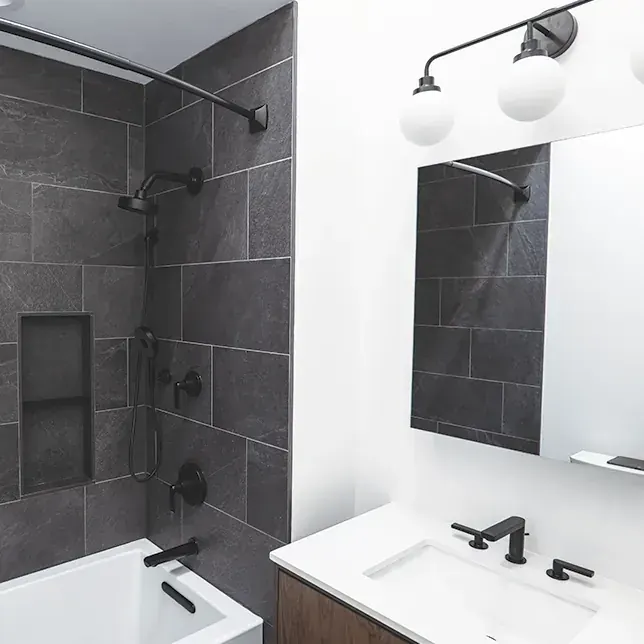
Maple and quarter-sawn white oak are the two species my shop reaches for most often on bathroom vanities. Wood species isn’t the variable that decides whether a vanity survives a bathroom long term, though. Finish quality and ventilation matter more, since no wood species is truly waterproof. Every species eventually fails if water sits against it repeatedly with no ventilation and a weak finish protecting it.
This article is part of our custom cabinets guide. For cabinetry built for your home, see custom cabinetry and millwork in the Hudson Valley.
Why Bathroom Vanities Fail Faster Than Kitchen Cabinets
A bathroom is a harsher environment for wood than a kitchen. Showers push humidity far higher than a kitchen ever sees. A vanity also sits directly under a sink, where a slow drip or a splashed puddle can sit against the cabinet base for hours before anyone notices. Kitchen cabinets deal with occasional splashes. Bathroom vanities deal with sustained humidity cycles and direct water contact at the same spot, day after day. That’s why a wood species and finish combination that holds up fine in a kitchen can fail years faster under a bathroom sink. If you’re weighing options for a specific bathroom, contact us and we’ll talk through what fits your space.
Maple — The Shop’s Default Choice
Maple is dense, tight-grained, and takes both paint and stain evenly. That’s why my team reaches for it as the default species on most vanity builds. Its tight grain structure keeps it from absorbing moisture as readily as a more open-grained species like oak, as long as the finish stays intact. Maple also holds its shape well relative to many other domestic hardwoods, which matters in a room with big daily humidity swings from showers.
Quarter-Sawn White Oak — More Stable, More Expensive
A mill cuts quarter-sawn white oak so the growth rings run nearly perpendicular to the face of the board. That cut makes the wood more dimensionally stable than plain-sawn oak and less prone to cupping as humidity cycles. It costs more than maple, both in raw material and in milling, since quarter-sawing produces more waste per log. For a vanity that sees heavy daily humidity swings, that added stability can be worth the premium. This especially holds true on a wider single-slab vanity top or apron, where movement would show the most.
Teak and Other Naturally Water-Resistant Species
Teak contains natural oils that resist water and rot, which is why it’s the standard choice for outdoor furniture and boat decking. It performs well in a bathroom for the same reason. It costs more and takes more effort to source for cabinetry than maple or oak, though, and its distinct golden-brown color and oily grain won’t take paint the way maple does. Teak is a strong choice specifically when the goal is a natural wood look with maximum moisture tolerance, not when the plan calls for a painted vanity.
What to Avoid in a Bathroom
- Untreated MDF in direct splash zones. MDF swells and delaminates once moisture breaches the finish, and unlike solid wood, it won’t dry back out.
- Softwoods like pine in high-humidity, low-ventilation bathrooms without a strong topcoat. Pine is soft and dents easily when it gets wet and dries repeatedly.
- Any species with a weak or single-coat finish directly under the sink basin, regardless of how water-resistant the species itself is.
Solid Wood vs. Plywood Construction for Vanities
Solid wood face frames and doors are standard for the visible parts of a vanity. The cabinet box itself, though, often uses a plywood core rather than solid wood panels. Plywood’s cross-grain layers resist warping better than a wide solid wood panel would in a humid room, since a solid panel that size tends to cup and move with humidity more. This is standard, high-quality cabinet construction, not a shortcut. Solid wood works best where you see it. Plywood is often the stronger choice where it’s structural.
Finish Matters as Much as Species
A vanity with a properly sprayed, multi-coat, catalyzed finish outperforms a “better” wood species with a thin, single-coat finish. The finish acts as the actual barrier between the wood and the water. Species selection only determines how the wood behaves if that barrier gets breached by a chip, a scratch, or years of wear. It doesn’t determine whether water reaches the wood in the first place. For guidance on the right finish for your specific vanity, contact us directly.
How Timber Can Help
My team at Timber Design + Build builds bathroom vanities out of our Marlboro shop using species matched to how the room gets used. That might mean maple for a painted vanity, quarter-sawn white oak for a stained piece that needs extra stability, or teak for a natural wood look in a high-moisture bathroom. Amanda Barton models every vanity in Chief Architect 3D so we confirm sizing and finish before we cut anything, and the same crew that designs it builds and installs it.
Every kitchen and vanity project we build is different, so pricing depends on scope, materials, and layout. For pricing and a quote, contact us here.
Serving Marlboro, New Paltz, Wallkill, and the Hudson Valley.
Frequently Asked Questions
What wood doesn’t warp from humidity in a bathroom?
Quarter-sawn white oak is one of the more dimensionally stable options because of how the board is cut relative to the growth rings. Teak resists moisture damage due to its natural oil content. No species fully resists movement, but these two hold up better than most under repeated humidity cycles.
Can you use regular cabinet wood in a bathroom?
Standard cabinet species like maple and oak work fine in a bathroom as long as the finish stays properly sprayed and maintained. The bigger risk isn’t the species itself. It’s using a thin or single-coat finish that wasn’t built for sustained humidity exposure.
Is plywood better than solid wood for vanities?
For the cabinet box structure, plywood often performs better than solid wood, since its cross-grain layers resist warping in a humid room more than a wide solid wood panel would. Solid wood still wins out for doors and face frames, where appearance matters most.
How do you protect a wood vanity from water damage?
A properly sprayed, multi-coat, catalyzed finish serves as the main line of defense, since it forms the barrier between the wood and water, not the species alone. Good bathroom ventilation and wiping up standing water around the sink base also extend a vanity’s life significantly.
Jeff Wiegmann is a Licensed General Contractor and Co-Founder of Timber Design + Build. Our team designs, builds, and installs custom millwork from our Marlboro shop at 168 Mt. Zion Road. We’ve matched 19th-century profiles for historic homes, always with the same crew from design to install.