
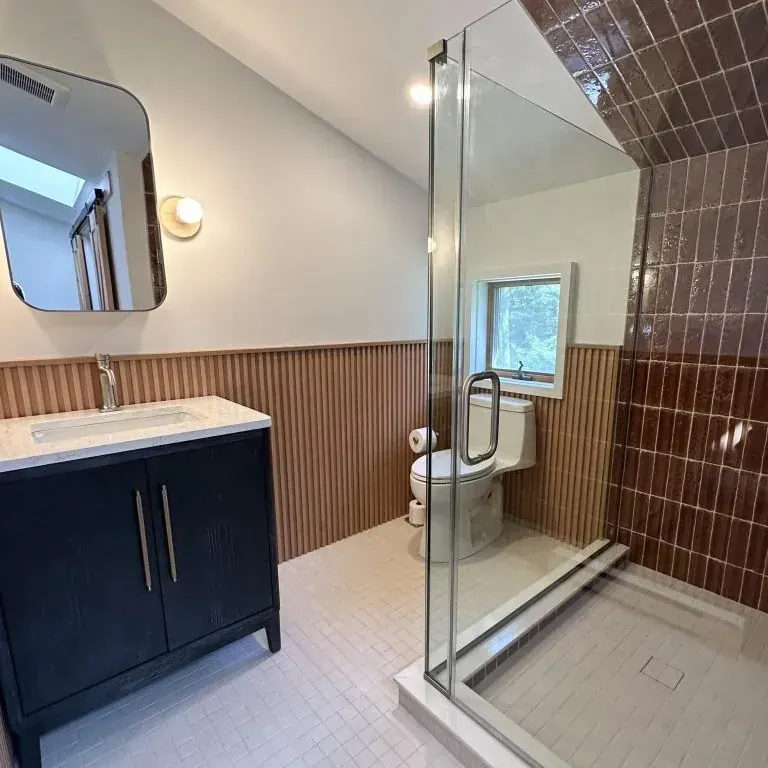
Wainscoting is decorative paneling that covers the lower part of a wall, usually topped by a cap or chair rail. It protects plaster and drywall from chairs and scuffs, and it adds depth. It is not a fix for a damp wall: wood and MDF fail where water sits.
Wainscoting is one form of custom millwork. This guide covers the main styles, how high to run the panels, which materials hold up, and the rooms where it works.
What is wainscoting?
Wainscoting is a band of wood or panel material applied to the lower third or so of an interior wall. A horizontal cap or chair rail finishes the top edge. A baseboard finishes the bottom. Between them sit panels, boards or battens, depending on the style you choose.
The name comes from wainscot, an old term for fine-grade oak boards. Early wainscoting was practical. It covered cold walls and took the knocks that plaster could not.
Today the job is mostly visual. Wainscoting adds shadow lines and texture. It also gives a hard-wearing surface in halls, stairs and dining rooms.
Most wainscoting has the same basic parts:
- Cap or chair rail. The top molding along the upper edge.
- Field. The panels, boards or battens between cap and base.
- Stiles and rails. The vertical and horizontal frame pieces in panel styles.
- Baseboard. The bottom trim that meets the floor.
What are the main styles of wainscoting?
The five main styles are raised panel, flat or recessed panel, beadboard, board and batten, and overlay or picture-frame molding. Raised and flat panels use a frame of stiles and rails. Beadboard uses narrow grooved boards. Board and batten uses vertical strips over a flat backer. Overlay applies molding directly to a flat wall.
| Style | What it looks like | Feel | Typical rooms | Watch for |
|---|---|---|---|---|
| Raised panel | A frame around panels with beveled, raised centers | Formal and traditional | Dining rooms, libraries, stair halls | Most joinery; needs room to move |
| Flat or recessed panel | A frame around flat panels set back from it | Clean, Shaker or Craftsman | Halls, mudrooms, offices | Simple lines show any uneven reveal |
| Beadboard | Narrow vertical boards with a bead at each joint | Casual, cottage | Bathrooms, kitchens, porches | Many seams; seal them in wet rooms |
| Board and batten | Vertical battens over a flat backer | Plain, farmhouse | Entries, mudrooms, tall walls | Runs higher than other styles |
| Overlay or picture frame | Molding boxes applied to a flat painted wall | Light and formal | Dining rooms, stair walls | Shows every dip in the wall behind |
Match the style to the house. A raised panel looks at home in a Federal-style house. It can look stiff in a plain farmhouse. Beadboard suits the farmhouse and can look thin in a formal dining room.
Wainscoting with beadboard looks sharper with a frame. A flat rail runs along the top and bottom, with beadboard between them. You keep the cottage look and gain a cleaner edge.
Ready-made wainscoting panels are sold as sheets and kits. They go up faster. Custom panels are sized to the wall, so the frames land evenly at corners, doors and windows.
How high should wainscoting be?
A common rule is to run wainscoting about one-third of the wall height. On an 8-foot wall, that lands near 32 to 36 inches. Taller styles, such as board and batten, often run to two-thirds of the wall. Avoid stopping at the halfway point. It cuts the wall into two equal bands that look static.
Height also follows the room’s other lines. Line the cap up with window sills where you can. Plan around switches and outlets so the cap does not split them.
Ceiling height changes the math. A 10-foot room can carry taller wainscoting than an 8-foot room. Mark the cap line on the wall with painter’s tape. Then judge it from the doorway.
On a stair, the cap runs parallel to the handrail. The panel frames follow the slope of the stair.
What is wainscoting made of?
Wainscoting is made from solid wood, MDF, plywood or PVC. Solid hardwood such as oak or cherry suits a stained finish. Poplar is the usual choice for paint-grade solid wood. MDF is smooth and stable, but it swells if water reaches an unsealed edge. PVC handles wet areas and takes paint only.
- Solid hardwood. White oak, red oak, cherry, walnut and maple take stain. Every joint and grain change shows under a clear finish.
- Poplar. A paint-grade hardwood. It holds nails and resists dents better than MDF.
- MDF. Takes paint smoothly and stays flat in dry rooms. Prime every face and edge.
- Plywood. Used for flat panels, with a hardwood veneer face for stain.
- PVC. Waterproof and paintable. It does not take stain.
Solid wood moves with the seasons. Raised and flat panels float in grooves in their frames, so they can expand and shrink. Do not glue a solid wood panel into its frame. It will crack, or it will split the joint.
Which rooms suit wainscoting?
Wainscoting suits dining rooms, halls, stairways, mudrooms, home offices and bathrooms. Halls and mudrooms gain a tough surface at the height where bags, boots and shoulders hit the wall. Dining rooms gain a chair rail. Avoid it on walls that stay damp, and on short walls broken up by doors and windows.
A few wainscoting ideas that fit specific rooms:
- Entry or mudroom. Tall board and batten, with hooks on the top rail.
- Dining room. Raised or flat panels under a chair rail.
- Stairway. Overlay frames that step up with the stairs.
- Bedroom. Tall flat panels behind the bed in place of a headboard.
- Kitchen. Beadboard on the back of an island.
Wainscoting can also tie a room to its other woodwork. Match the cap profile to the window casing or the mantel. The room then reads as one design.
Can you put wainscoting in a bathroom?
Yes, if the material and finish can handle moisture. Use PVC, moisture-resistant MDF or well-sealed solid wood. Prime and paint every face, including the back and cut edges, before installation. Keep the bottom edge off the floor tile and caulk the joints. Do not run wood wainscoting inside a shower or tub surround.
The bathroom fan matters as much as the material. Steam that cannot leave the room ends up in the wood. Run the fan during and after every shower.
Beadboard is the classic choice for wainscoting in the bathroom. Run it high enough to cover the splash zone around the sink. Finish it with a hard paint that you can wipe clean.
What is the difference between wainscoting and paneling?
Wainscoting covers only the lower part of a wall and ends at a cap or chair rail. Paneling covers the wall from floor to ceiling. Both can use the same panels, boards and moldings. The difference is coverage and effect: wainscoting adds a band of detail, while full paneling sets the tone of the whole room.
Full paneling suits libraries, studies and dens. It takes more material and more planning around windows, doors and built-ins. Wainscoting is the lighter commitment. It leaves the upper wall free for paint, paper or art.
Old houses add a layer of work. Timber’s custom millwork page notes that walls out of parallel and floors out of level are normal in Hudson Valley homes built before 1990. Panels must be scribed and fitted to those walls. Stock kits assume a flat, square room.
Cost depends on size, material, profile and finish. Get a drawing of the wall before you get a price. Timber Design + Build runs a millwork and cabinet shop in Marlboro, NY. Its designs are drawn in Chief Architect, and clients approve 3D renderings before material is ordered. Its page on custom millwork in the Hudson Valley explains the process.
FAQ
Is wainscoting out of style?
No. Wainscoting has been used in houses for centuries, and it still goes into new homes. Particular styles go in and out of fashion more than the idea does. A style that matches the house dates more slowly than one picked from a trend.
Can you install wainscoting over drywall?
Yes. Most wainscoting goes over existing drywall or plaster. Panels and battens are fastened to the studs and glued to the wall. Check the wall for flatness first, because overlay frames show every dip.
What is the difference between wainscoting and a chair rail?
A chair rail is a single molding run across the wall near chair-back height. Wainscoting is the full treatment below it: panels or boards, a cap and a baseboard. A chair rail can stand alone. Wainscoting usually includes one as its top edge.
Should wainscoting be painted or stained?
Either works. Paint suits MDF, poplar and most beadboard, and it hides seams. Stain suits solid hardwood with matched grain. A stained finish shows every joint, so it takes more careful board selection.