
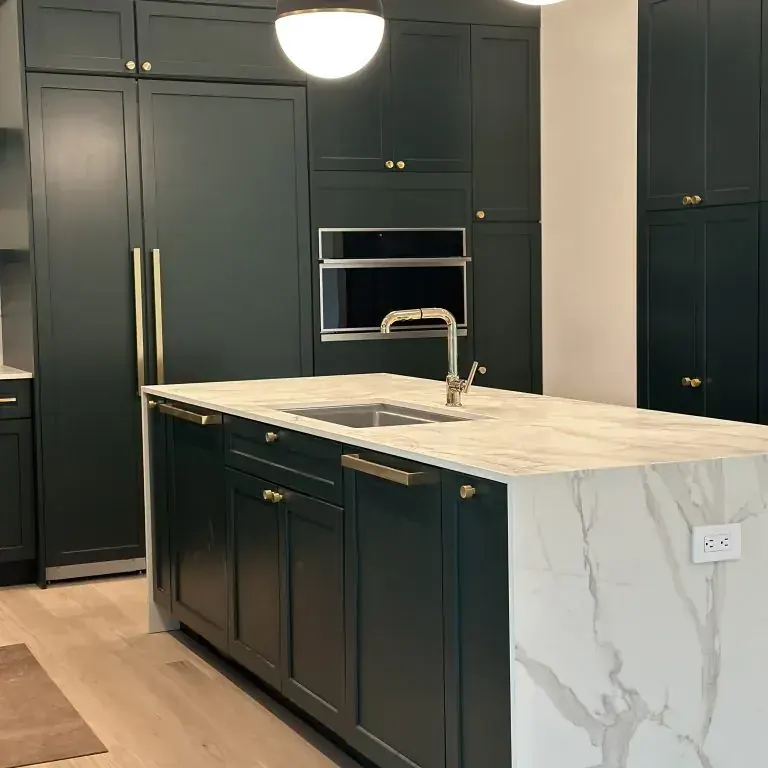
Cabinet hardware placement follows a few common conventions. On doors, knobs and pulls go on the side opposite the hinges, near the top corner of base cabinets and the bottom corner of wall cabinets. On drawers, hardware is usually centered across the width.
There is no building code or single standard for any of this. The conventions exist because they put hardware where your hand falls. This spoke of our custom cabinet guide covers each cabinet type, then the install.
Where do knobs go on cabinet doors?
Knobs go on the door stile opposite the hinges, near the corner. On base cabinets, place them near the top corner. On wall cabinets, place them near the bottom corner. A common convention sets the knob center about 2 to 3 inches in from each edge, or centered on the stile of a frame-and-panel door.
The logic is reach. You open a base cabinet from above, so the knob sits high. You open a wall cabinet from below, so the knob sits low.
On a Shaker or frame-and-panel door, the stile gives you a guide. Centering the knob on the stile width usually looks right. Keep the same distance from the rail on every door.
Where do pulls go on cabinet doors?
Pulls on doors usually run vertically on the stile opposite the hinges. On base doors, the top of the pull sits a few inches below the top edge. On wall doors, the bottom of the pull sits a few inches above the bottom edge. Center the pull side to side on the stile.
Line up the ends of the pulls, not the centers. When pulls of one size share a row, aligned ends make a clean line across the doors.
On a corner or lazy Susan door, check where the doors meet. Hardware placed too close to the fold can pinch fingers or strike the next door.
Where should hardware go on drawers?
Drawer hardware is usually centered across the width of the drawer front. Vertically, slab fronts get hardware centered on the height. Shaker fronts get it centered on the front or on the top rail. Whichever you choose, use it on every drawer in the run so the lines read straight.
Deep drawers need a decision. Centered hardware on a tall pot drawer can sit low and feel awkward to reach. Many layouts place it in the upper third, or on the top rail.
Look at the whole bank of drawers together. Hardware on a stack of drawers reads as one vertical line. If one drawer breaks the pattern, it stands out.
| Location | Knob placement | Pull placement |
|---|---|---|
| Base cabinet door | Top corner on the opening side, about 2 to 3 in from each edge | Vertical on the stile, top end a few inches below the top edge |
| Wall cabinet door | Bottom corner on the opening side, about 2 to 3 in from each edge | Vertical on the stile, bottom end a few inches above the bottom edge |
| Tall pantry door | Near the height of the counter, on the opening side | Long vertical pull, centered near counter height |
| Slab drawer front | Centered on width and height | Horizontal, centered on width and height |
| Shaker drawer front | Centered on the top rail or on the front | Horizontal, on the top rail or centered on the front |
| Deep drawer | Upper third or on the top rail | Horizontal, upper third or on the top rail |
| Wide drawer | Two knobs, spaced evenly | Two pulls, or one long pull |
| Sink false front | Often none, or a matching knob for symmetry | Often none, or a matching pull for symmetry |
Treat every row as a convention, not a rule. Your hands and your layout decide the final call.
What size pulls should you use on drawers?
A common rule of thumb sizes drawer pulls at about one-third of the drawer width. It is a guide, not a rule. Pulls are sold by center-to-center hole spacing, such as 3 inches, 96 mm, 128 mm and 160 mm. Wide drawers, over about 30 to 36 inches, often get two pulls or one long one.
Center-to-center spacing is the distance between the two screw holes. It is not the overall length of the pull. Check both numbers before you order.
Keep sizes consistent within a run. Using one or two pull sizes across a kitchen usually looks calmer than five.
Do not order hardware before the cabinet sizes are final. A drawer that shrinks by a few inches can make your chosen pull look too long.
How does hardware placement change for inset, Shaker and tall cabinets?
Inset doors sit inside the face frame, so hardware goes on the door itself, with clearance from the frame edge. Shaker doors give the stile and rail as natural guides. Tall pantry and appliance doors usually take longer pulls, placed where your hand falls, often near counter height.
Inset doors close flush with the frame. A knob placed too close to the edge can catch on the frame or your knuckles. Our article on inset vs. overlay cabinets explains how each door style sits in the box.
Full overlay doors sit close together. Check that hardware on neighboring doors and drawers will not collide when both open.
Check clearance at walls and appliances too. A pull beside a refrigerator or a wall can stop a drawer from opening fully.
How do you install cabinet hardware without mistakes?
Decide placement during design, mark it with a template or jig, and drill from the front with a backer block behind. Test the layout on one door with painter’s tape first. Check clearances at corners, walls and appliances. A misplaced hole cannot be fully hidden, so measure twice before you drill.
A drilling jig keeps every hole at the same distance from the edges. That matters more than the exact number you choose.
On custom work, placement is often settled earlier. Timber specifies hardware during the design phase and can source pulls, knobs and hinges from any manufacturer. Its shop machines doors for hinge cups and pull hardware, then installs hinges, drawer slides and pulls at installation. That sequence is part of its custom cabinetry in the Hudson Valley.
FAQ
Should you use knobs or pulls on kitchen cabinets?
A common approach puts knobs on doors and pulls on drawers. Pulls on everything also works, and suits modern kitchens. Mixing is fine if you apply the same pattern across the whole room.
How far from the edge should cabinet knobs be?
A common convention places the knob center about 2 to 3 inches from the side and the top or bottom edge. On a frame-and-panel door, centering the knob on the stile width usually looks balanced.
Do cabinet pulls go horizontal or vertical?
Pulls on doors usually run vertically, and pulls on drawers usually run horizontally. That matches the direction your hand moves to open each one.
Does a sink false front need hardware?
A false front does not open, so it needs no working hardware. Many kitchens add a matching knob or pull anyway, so the row of drawers looks even. If the false front is a tip-out tray, it needs hardware to open.