
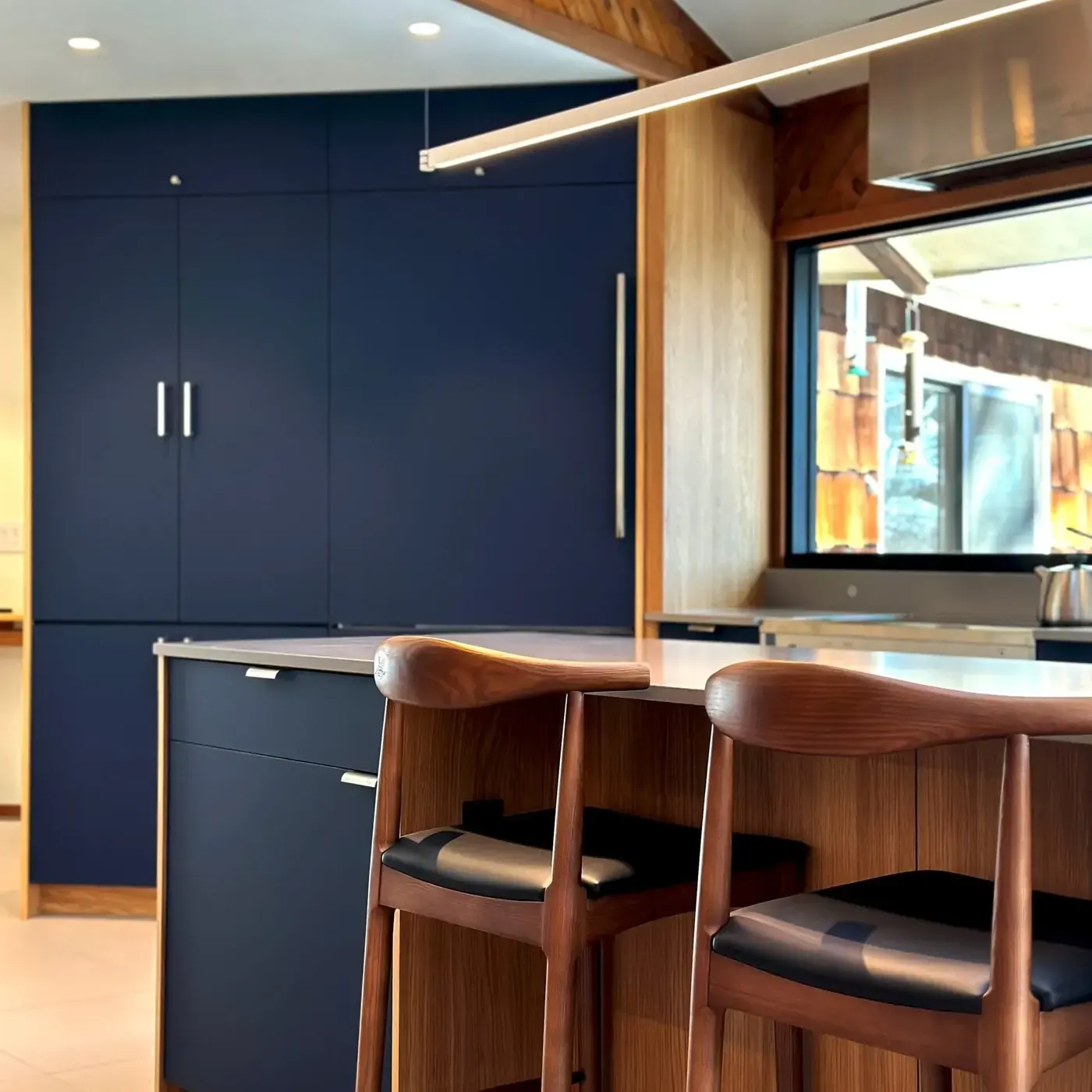
Painted cabinets chip because paint sits on top of the wood as a film instead of soaking into it the way a stain does. Any film coating fails first at a point of impact or stress. That’s why chipping shows up at corners, edges, and hinge points long before it shows up on a flat door panel. Paint brand isn’t the variable that determines how bad the chipping gets over time. The substrate underneath and the finish process used to apply it matter far more.
This article is part of our custom cabinets guide. For cabinetry built for your home, see custom cabinetry and millwork in the Hudson Valley.
Paint Is a Film, Not a Stain
A stain penetrates into the wood grain and becomes part of the surface. Paint sits on top as a coating, usually built up in layers: a primer coat, then color coats, then in a well-built cabinet, a clear topcoat for durability. That layered film has to flex with the wood underneath as the wood expands and contracts with seasonal humidity. Wood moves. Paint film doesn’t move nearly as much, and that mismatch eventually cracks the film at a stress point.
Why Corners and Edges Chip First
Corners and edges take the most physical contact in daily use. A bag hits the corner of an island cabinet. A pot lid grazes a door edge. A hand pushes a drawer front closed at an angle instead of straight on. Paint film also runs naturally thinner at a sharp edge than on a flat surface, since the coating pulls back slightly from a crisp corner during application and cure. Thinner film at the point of most contact is exactly the combination that produces chipping first at edges and corners.
MDF vs. Solid Wood — Does the Substrate Matter?
MDF (medium-density fiberboard) actually offers a smoother substrate for paint than solid wood in one specific way: it has no grain telegraphing through the finish, so a painted MDF door can look flawless right out of the shop. But MDF faces a different failure mode. If moisture gets past the paint film at a chip or a seam, MDF can swell locally, which cracks the paint further from underneath rather than the surface wearing down from outside contact. Solid wood doesn’t swell from surface moisture the same way, but it does move seasonally with humidity, which stresses the paint film differently. Neither substrate resists chipping completely. They chip for different underlying reasons, so if you’re unsure which substrate fits your project, contact us and we’ll walk through the tradeoffs.
Why the Finish Process Matters More Than the Paint Brand
A sprayed finish with a proper primer, multiple thin color coats, and a catalyzed topcoat like a conversion varnish holds up dramatically better than a brushed finish with one or two coats of standard cabinet paint, regardless of which brand is on the can. Conversion varnish cures into a harder, more chemical-resistant film than standard latex or alkyd paint. That’s why custom shops rely on it as a standard topcoat rather than relying on site-painted work. The number of coats, the cure time between coats, and whether the shop sprayed or brushed the finish all matter more to long-term chip resistance than the specific paint product used.
Can Chipped Paint Be Fixed?
You can touch up small chips, but a touch-up rarely matches the sheen and color of a factory or shop-sprayed finish exactly, since spraying a small spot repair with the same even coverage as the original full-door application is nearly impossible. Widespread chipping across multiple doors usually means the door needs a full strip and refinish rather than a spot repair, especially if the chipping has exposed bare substrate in more than a few places. If that’s the situation you’re facing, contact us and we can take a look at what’s salvageable.
How to Get Painted Cabinets That Hold Up
The combination that resists chipping longest starts with a solid wood or high-quality MDF door, sprayed with a primer and multiple color coats, and finished with a catalyzed topcoat rather than a standard paint sheen. Softened or eased edges also hold paint film better than perfectly sharp corners, since the film has more material to grip on a slightly rounded edge instead of pulling thin at a knife-edge corner.
How Timber Can Help
My team at Timber Design + Build sprays every painted cabinet in our Marlboro shop with a primer coat, multiple color coats, and a catalyzed topcoat, not a brushed finish, because that process actually resists chipping at corners and edges over years of daily use, not just at installation. Amanda Barton designs every kitchen in Chief Architect 3D so we decide door style and edge profile up front, and the same crew that designs the kitchen builds and installs it, start to finish.
Every kitchen we build is different, so pricing depends on scope, materials, and layout. For pricing and a quote, contact us here.
Serving Marlboro, New Paltz, Wallkill, and the Hudson Valley.
Frequently Asked Questions
Why do cabinet corners chip first?
Corners take the most physical contact in daily use, and paint film naturally thins slightly at sharp edges during application. Thinner film at the point of most impact is why corners and edges chip before flat panel surfaces do.
Can chipped cabinet paint be fixed?
You can touch up small isolated chips, though the repair rarely matches the original sheen exactly. Widespread chipping usually means the door needs a strip and refinish rather than a spot repair.
Do all painted cabinets eventually chip?
Some degree of chipping over enough years is realistic for any painted surface, since paint is a film that has to flex with wood movement. A properly sprayed finish with a catalyzed topcoat delays and reduces chipping significantly compared to a brushed, single-coat finish.
Is factory paint better than site-painted cabinets?
Shop-sprayed finishes with a primer, multiple color coats, and a catalyzed topcoat generally outperform site-painted cabinets, which often get brushed or rolled with fewer coats. The finish process matters more to durability than whether it happened in a factory or a custom shop, as long as the shop sprays the finish and uses a hard topcoat.
Jeff Wiegmann is a Licensed General Contractor and Co-Founder of Timber Design + Build. Our team designs, builds, and installs custom millwork from our Marlboro shop at 168 Mt. Zion Road. We’ve matched 19th-century profiles for historic homes, always with the same crew from design to install.