
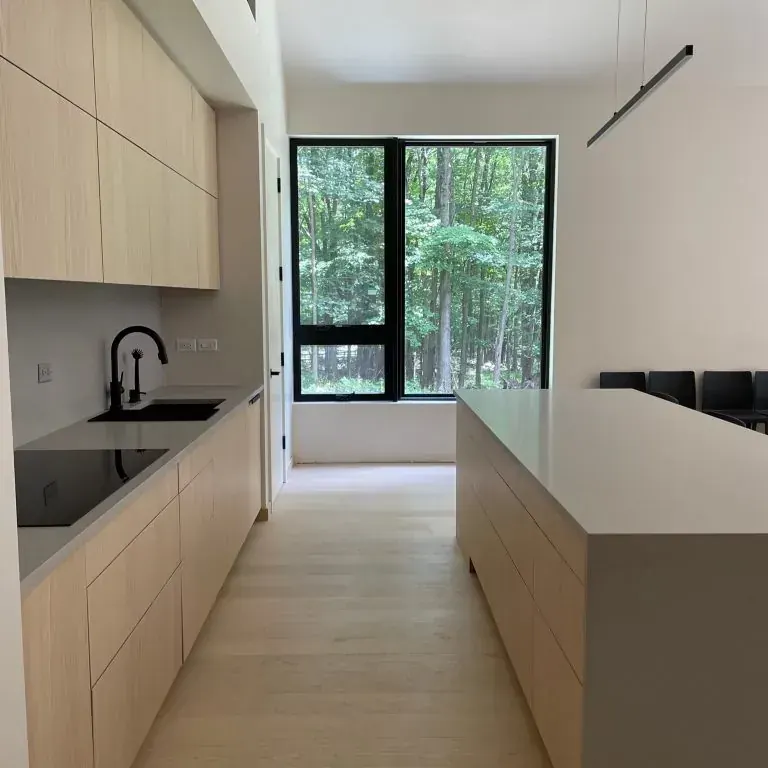
Custom cabinetry is typically priced as part of a full kitchen remodel. Kitchen size isn’t the variable that moves that number the most. Wood species and door style drive it more, since those two decisions set both material cost and the hours my shop spends building and finishing each piece.
This article is part of our custom cabinets guide. For cabinetry built for your home, see custom cabinetry and millwork in the Hudson Valley.
What Actually Drives Custom Cabinet Cost?
Four things determine where a custom cabinet job lands on the budget spectrum: wood species, door style, finish, and layout complexity. A straightforward run of painted Shaker doors in a standard rectangular kitchen costs less per linear foot than an inset, raised-panel kitchen in walnut with a hand-rubbed finish. None of these factors work alone. A hard wood species paired with a simple door style can land in a similar range as a soft wood species paired with a labor-intensive door style. Total shop hours set the price, not any single line item.
Wood Species and Its Effect on Price
Wood species is usually the first cost lever people ask about, and it matters, but it’s not the only one. Species like maple and oak sit on the lower to middle end of what custom shops typically charge. Species like walnut and quarter-sawn white oak run higher because of material cost and, in walnut’s case, waste factor during milling. Since lumber markets shift species pricing, a direct conversation with our shop gives you the most accurate comparison for your project. You can contact us to talk through species options for your kitchen.
Door Style and Finish
Door style changes labor more than it changes materials. A flat-panel or slab door takes less bench time than a raised-panel or inset door. Raised-panel and inset styles need individual shaping or hand-fitting on every panel or opening. Finish adds another layer. A painted finish has to look flawless under raking light, so it takes more prep and more coats than a stained finish, which can lean on the wood grain to hide minor imperfections. Finish upcharges depend on the specific door style and coat count, so we work that out project by project.
Layout Complexity and Custom-Fit Work
A kitchen with a standard rectangular layout and no structural obstructions is the fastest and least expensive to build for. A kitchen with uneven walls, a non-standard ceiling height, or a structural post in the middle of a run takes more design and fitting time before a single board gets cut. The same goes for matching an existing 19th-century profile. That extra time in the design and fitting phase, not just the build phase, is part of what separates a custom job’s cost from a stock or semi-custom job’s cost.
What Drives Your Total, at a Glance
| Factor | What moves the cost |
|---|---|
| Wood species | Maple and oak typically land lower. Walnut and quarter-sawn white oak typically land higher due to material cost and milling waste. |
| Door style | Slab and flat panel take less bench time than raised panel or inset. |
| Finish | Painted finishes generally need more prep and coats than stained. |
| Layout complexity | Uneven walls, structural obstructions, or historic profile matching add design and fitting time. |
Why Custom Costs More Than Stock, and What You Get for It
Custom costs more than stock or semi-custom because a shop builds every piece to order rather than pulling it from a modular sizing system. That process buys you a kitchen with no filler panels, no compromise on layout, and full control over wood species, door style, and finish. It’s also the only path to matching an existing profile in a historic home, since stock and semi-custom lines can’t do that at all. Whether that difference is worth it depends on your house and your goals, not just your budget. A standard-layout kitchen in a newer home may not need the flexibility custom offers. An older Hudson Valley home with an irregular layout usually does. If you’re not sure which side of that line your project falls on, contact us and we’ll walk through it together.
How Timber Can Help
My team at Timber Design + Build designs, builds, and installs every custom kitchen out of our Marlboro shop. Amanda Barton models the full job in Chief Architect 3D before we cut anything, so you see a real design tied to your actual kitchen, not a rough guess based on square footage. The same crew handles design, build, and install from start to finish, and we match 19th-century profiles when the project calls for it.
Every kitchen we build is different, so pricing depends on scope, materials, and layout. For pricing and a quote, contact us here.
Serving Marlboro, New Paltz, Wallkill, and the Hudson Valley.
Frequently Asked Questions
Why are custom cabinets so expensive?
A shop builds every custom cabinet to order for your specific kitchen rather than mass-producing it in fixed sizes. The added cost comes mostly from labor and material choice, not from markup on a standard product.
What’s included in custom cabinet pricing?
Custom cabinet pricing generally covers design and 3D modeling, material selection, bench construction, finish work, hardware, and installation. What’s bundled into a quote varies by shop, so it’s worth confirming scope directly with whoever prices your job.
How much should I budget for custom cabinets?
Custom cabinetry is typically part of a full kitchen remodel, so budget depends heavily on wood species, door style, finish, and layout complexity. Each of these shifts the total significantly. The most accurate way to get a number is a direct quote based on your specific project.
Do custom cabinets cost more than stock cabinets?
Yes. Custom cabinets cost more than stock cabinets because a shop builds them individually rather than manufacturing them in bulk at fixed sizes. The tradeoff is full control over fit, materials, and design that stock cabinetry can’t offer.
Jeff Wiegmann is a Licensed General Contractor and Co-Founder of Timber Design + Build. Our team designs, builds, and installs custom millwork from our Marlboro shop at 168 Mt. Zion Road. We’ve matched 19th-century profiles for historic homes, always with the same crew from design to install.