
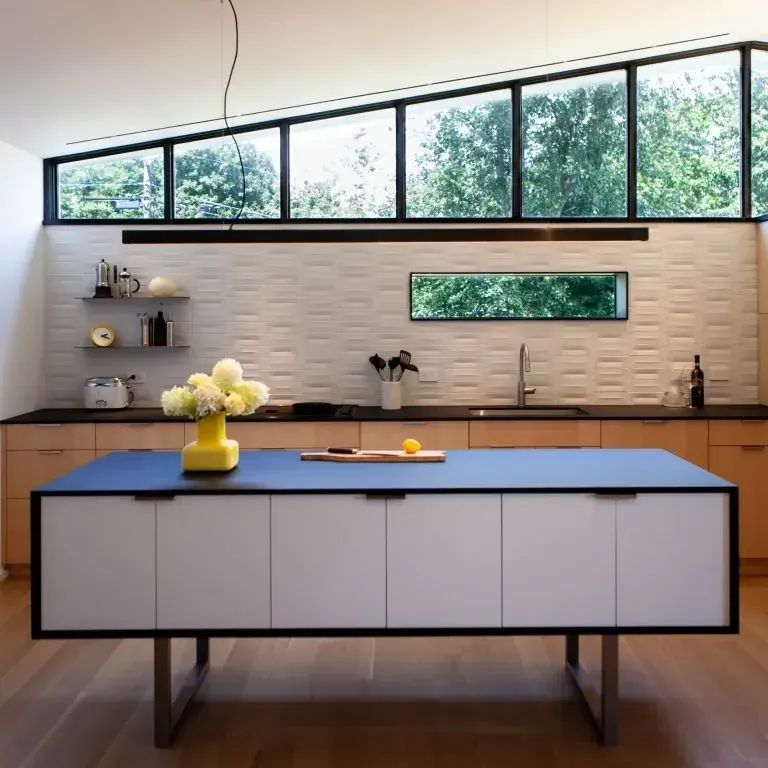
Shaker is a door style my shop builds often, but it isn’t automatically the right choice for your kitchen. The variable that should drive your decision is the architecture of the house, not what’s trending. A Hudson Valley farmhouse, a mid-century ranch, and a new-construction contemporary all call for a different door profile if you want the kitchen to actually look like it belongs in the house.
This article is part of our custom cabinets guide. For cabinetry built for your home, see custom cabinetry and millwork in the Hudson Valley.
Shaker Doors — The Style Everyone Asks For
A shaker door is a five-piece door: four flat rails and stiles framing a recessed center panel, with clean, square edges and no ornamentation. It’s built using a cope and stick joinery method, which is standard in custom cabinet shops because it produces a strong, stable joint that won’t rack over time. Shaker reads as clean in a modern kitchen and appropriately simple in a farmhouse kitchen, which is why it works across more house styles than almost any other door.
The tradeoff is that shaker has become the default, so a shaker kitchen can look like every other shaker kitchen unless you get specific about wood species, finish, and hardware. My team differentiates shaker jobs mostly through the finish and the profile detail on the rail edge, not the door shape itself.
Slab Doors — The Modern, Minimal Option
A slab door is a single flat panel with no frame or center detail at all. It’s the door style behind most frameless, European-style kitchens, and it’s the cleanest option if you want the cabinetry to disappear visually and let the countertop or backsplash carry the design. Slab doors show every fingerprint and water spot more than a paneled door, so they need a finish that can handle daily wiping, and grain-matching across a full wall of slab doors takes more care at the bench than matching a paneled door.
Raised Panel Doors — Traditional and Formal
A raised panel door has a center panel that’s shaped and beveled so it sits proud of the surrounding frame, catching light and shadow differently than a flat panel. This is the door style you’ll see in older, formal kitchens and in period-correct builds for pre-1900 homes. It’s more labor-intensive to produce than shaker because the panel has to be shaped on a router table or shaper, not just cut flat. Raised panel can read as dated in a strictly contemporary house, but it’s the correct historically accurate choice when we’re matching original millwork in an older Hudson Valley home.
Flat Panel Doors — Where Shaker Came From
A flat panel door is the same five-piece construction as shaker, but without the sharp, square profile on the rails and stiles. Some flat panel doors have a soft, rounded edge instead of shaker’s flat one. This is a subtler, quieter version of shaker that works well in transitional kitchens where you want a paneled look without the more graphic shaker lines.
Beadboard, Louvered, and Glass-Front — The Specialty Styles
- Beadboard doors have vertical grooves cut into the center panel, giving a cottage or farmhouse look. Common on pantry doors and end panels more than full kitchens.
- Louvered doors use angled wood slats instead of a solid panel, traditionally used for ventilation on utility cabinets, laundry doors, or wine storage.
- Glass-front doors replace the center panel with glass, usually paired with interior lighting, and work best on upper cabinets used to display dishware rather than lower cabinets holding pots and pans.
Which Style Holds Up Best in a Working Kitchen?
| Style | Maintenance | Best use case | Timber’s take |
|---|---|---|---|
| Shaker | Low — flat surfaces wipe clean, recessed panel hides minor wear | Farmhouse, transitional, most kitchens | Our most-built door for a reason: it works in almost any house |
| Slab | Higher — shows fingerprints and water spots on a fully flat, unbroken surface | Modern, frameless, minimalist kitchens | Great look, but plan on wiping it down more often |
| Raised panel | Moderate — more surface detail collects dust in the panel shadow lines | Formal, traditional, historic homes | The right call for period-correct restoration work |
| Flat panel | Low, similar to shaker | Transitional kitchens wanting a softer look than shaker | Underused option, quieter than shaker without going fully modern |
| Glass-front | Higher — glass shows smudges, interior needs to stay tidy since it’s visible | Display cabinets, upper cabinets near a dining area | Use sparingly, as an accent, not on every upper |
How Timber Can Help
My team at Timber Design + Build builds all of these door styles out of our Marlboro shop, and every kitchen is designed in Chief Architect 3D before we cut anything, so you can see shaker next to slab next to raised panel in your actual floor plan and pick based on how it looks in your house, not a showroom. Amanda Barton runs that design process. The same crew that designs your kitchen builds it and installs it, start to finish, and we match 19th-century profiles when a historic home calls for it.
Every kitchen we build is different, so pricing depends on scope, materials, and layout. Door style choice has a modest effect on price, mostly through labor on more detailed profiles like raised panel.
Serving Marlboro, New Paltz, Wallkill, and the Hudson Valley.
Frequently Asked Questions
What’s the difference between shaker and flat panel doors?
Both are five-piece doors with a recessed center panel, but shaker has a flat, square-edged frame while flat panel has a softer, often rounded edge. The difference is subtle and mostly shows up in how sharp or soft the door reads from a few feet away.
Are shaker cabinets still in style?
Yes. Shaker remains one of the most-requested door styles because it works in farmhouse, transitional, and modern kitchens alike, which is rare for a single profile. It’s less a trend and more a default that’s stayed in demand for decades.
Do raised panel cabinets look dated?
In a strictly contemporary house, raised panel can read as dated compared to shaker or slab. In a traditional or historic home, it’s the correct and expected style, not dated at all.
Which cabinet door style is easiest to clean?
Shaker and flat panel are the easiest to keep clean day to day since they don’t have deep carved detail or a fully flat surface that shows every mark. Slab and glass-front doors show fingerprints and smudges more readily and need more frequent wiping.
Jeff Wiegmann is a Licensed General Contractor and Co-Founder of Timber Design + Build. Our team designs, builds, and installs custom millwork from our Marlboro shop at 168 Mt. Zion Road. We’ve matched 19th-century profiles for historic homes, always with the same crew from design to install.