
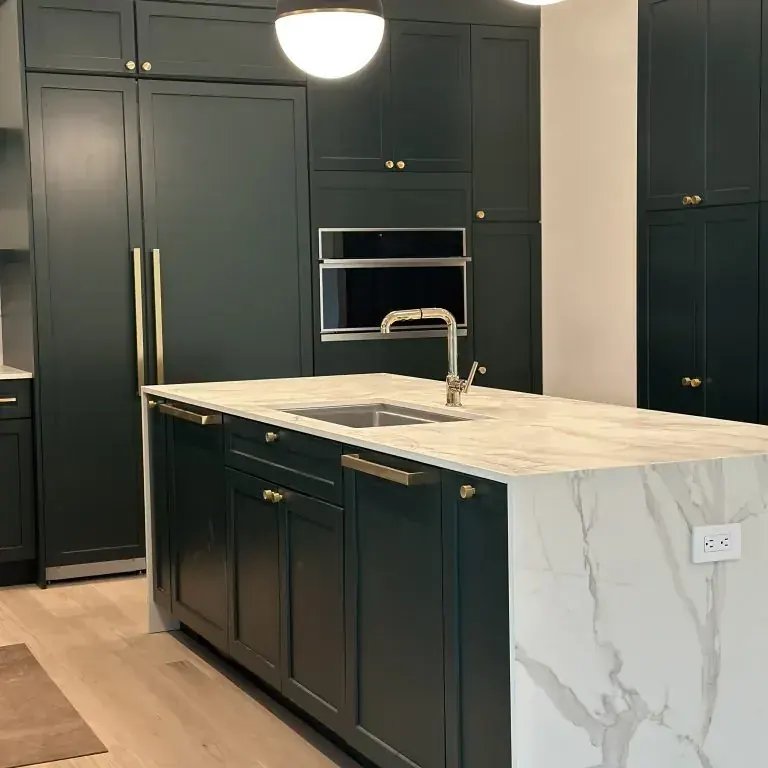
Face-frame cabinets have a solid wood border fastened to the front of the box; frameless cabinets have none, so the door covers the full face edge to edge. That single structural decision determines which door styles work, how much of the interior you can access, and what hardware the entire job gets built around.
This article is part of our custom cabinets guide.
In our Marlboro shop, we build both. The right choice isn’t about which construction is better in the abstract — it’s about which one matches your design direction, your door style, and how you plan to use the storage. Here’s how to make that call.
How Face-Frame and Frameless Cabinets Are Built
A face-frame cabinet starts with a plywood box, then adds a hardwood frame to the front. That frame is made up of stiles (the vertical pieces) and rails (the horizontal pieces), typically milled to 1-1/2″ wide and glued flush to the front edge of the box. In our shop, we mill the face frame from the same species as the door fronts: poplar for painted builds, hard maple or white oak when we’re staining.
The frame is what the eye reads when the door opens. On an inset door, the door sits flush inside the frame opening with a visible reveal. On a full overlay, the door covers most of the frame face. A partial overlay, it covers part of it. All three positions are possible because the frame gives you a structure to hinge against and lap over.
A frameless cabinet — also called European-style or full-access construction — skips the frame entirely. The door attaches directly to the inside wall of the box using a concealed cup hinge, and it covers the full front of the box. No frame underneath. The term full overlay follows from that: the door overlays the entire face of the box.
Box wall quality matters more on a frameless build. Because the face frame normally hides the plywood edge on a traditional cabinet, a frameless box requires clean edge banding on every exposed surface. We apply PVC edge banding or wood edge banding throughout our frameless builds. That edge is visible once the door opens. On a face-frame build, the frame covers it.
Box wall thickness is also non-negotiable in frameless construction. The concealed cup hinge drills into the interior side wall and needs solid material to hold the screw. Our frameless boxes run 3/4″ plywood throughout.
What the Frame Does to Interior Access
The face frame opening is smaller than the box opening. A 1-1/2″ stile on each side of a 24″ wide base cabinet leaves you with roughly a 21″ clear opening. That’s workable for standard drawer boxes and conventional pull-outs, but it’s a real restriction when you’re fitting wide rollout shelving, a pull-out trash insert, or a heavy undermount drawer system.
Frameless cabinets are called full-access for a reason: the opening equals the interior width of the box. When my team installs a kitchen remodel with deep Blum Tandem drawer stacks or wide rollout shelves, frameless construction simplifies the job. The slides mount flat to the side walls with nothing to notch around. This is one reason full-access construction dominates contemporary kitchen design while face-frame stays the standard in traditional American cabinet work.
If your design relies heavily on rollout shelving, wide drawer stacks, or pull-out inserts, frameless is the better-suited construction method. If your layout is mostly doors with moderate storage, face-frame handles it without compromise.
Door Styles, Hinges, and the Hardware That Follows
Face-frame construction gives you the widest range of door positioning. Inset, partial overlay, and full overlay all work because the frame provides a stop, a reveal, and a hinge surface. Traditional and transitional kitchens — the ones with visible hinges, beaded inset doors, or classic raised-panel profiles — almost always use face-frame construction. The look requires it structurally.
Frameless construction is built for full overlay. The door covers the entire front of the box, which produces the clean, hardware-free face common in contemporary and modern kitchens. You can approximate a partial overlay look on a frameless box, but full overlay is the natural fit for this method.
Hinge selection follows the same logic. Face-frame cabinets can use exposed butt hinges, semi-concealed hinges, or concealed cup hinges, depending on the door style. A traditional butterfly hinge or a classic antique brass butt hinge is a face-frame detail: the frame gives it a surface to mount against that reads correctly. Frameless cabinets use concealed cup hinges exclusively — typically Blum or equivalent European hardware. Those hinges clip to a mounting plate drilled into the inside wall and adjust in three directions during installation.
If you want to see the hinge, you need a face frame. If you want it hidden, either construction works for full overlay doors. Frameless is simply the industry standard method for a fully concealed hardware look.
For a related finish decision, see how painted vs. stained finishes interact with door profile choices — that decision often follows naturally from the construction type.
Which Construction Holds Up Better?
Both hold up well when built correctly. Construction quality at the box level matters more than whether a face frame is present.
The face frame does add stiffness to the front of the cabinet box. On a traditionally built American cabinet, the frame helps keep the case square and contributes a real mechanical connection at the front edge. That’s structural, not cosmetic.
Frameless construction compensates with thicker box walls and more demanding joinery. A frameless box built from 3/4″ plywood with proper dado joints, a solid back panel, and a well-fastened back wall is a rigid, long-lasting assembly. A frameless box built from 1/2″ particleboard with cam-lock hardware will rack and fail. The frame’s absence shifts the structural demand entirely onto the box itself.
When I’m evaluating cabinet quality in the field, I look at the box material, the joint construction, and the drawer system, not whether there’s a face frame. A well-built frameless cabinet outlasts a poorly built face-frame cabinet every time. For a closer look at how the substrate choice affects both construction types, see the breakdown of solid wood vs. MDF cabinet boxes.
How to Choose Between Face-Frame and Frameless
The decision comes down to three things: your design direction, your door style, and your storage priorities.
- Traditional, transitional, or farmhouse kitchen with inset or partial overlay doors and visible hinges: face-frame is the structurally correct choice. The look requires it.
- Contemporary or modern kitchen with full overlay or flat-front doors and concealed hardware: frameless is the natural fit.
- Heavy pull-out storage, wide rollout shelves, or large undermount drawer systems: frameless gives you the full box opening to work with.
- Historic home where you’re matching existing millwork: face-frame is the period-correct approach. In our Marlboro shop, we’ve matched 19th-century face-frame profiles for Hudson Valley homes.
Neither construction type restricts your material choices. We’ve built face-frame kitchens in white oak, maple, and cherry, and frameless kitchens with warm rift-sawn white oak fronts that read comfortably in a traditional farmhouse. The construction method is a structural foundation; the wood species, finish, and door profile carry the design.
Face-Frame vs. Frameless: Side by Side
| Feature | Face-Frame | Frameless | Timber’s Take |
|---|---|---|---|
| Interior access | Reduced by stile width: approx. 21″ opening on a 24″ base cabinet | Full box-width opening; no frame obstruction | Frameless is the better choice for wide drawers, rollouts, and pull-out inserts |
| Door position options | Inset, partial overlay, full overlay | Full overlay standard; partial overlay possible | Face-frame required for true inset and any visible-hinge look |
| Hinge options | Exposed butt, semi-concealed, or concealed cup | Concealed cup hinge only | Any visible hinge requires face-frame construction |
| Design style fit | Traditional, transitional, farmhouse, historic | Contemporary, modern, transitional | Let the door style and design direction lead — both work in transitional kitchens |
| Box material demand | Frame covers all plywood edges on the front | All edges exposed; quality edge banding required throughout | Frameless demands tighter tolerances and cleaner edge finishing |
| Cost difference | Quoted per project | Quoted per project | At the custom level, hardware is the main variable; overall cost is comparable |
Frequently Asked Questions
What is the difference between frameless and face-frame cabinets?
Face-frame cabinets have a hardwood frame (stiles and rails, typically 1-1/2″ wide) glued and fastened to the front of the cabinet box. Frameless cabinets have no frame; the door attaches directly to the interior wall of the box with a concealed cup hinge and covers the full front. That structural difference is what drives which door styles work, how much interior space you can access, and which hinge types are available on the build.
Are frameless cabinets more expensive than face-frame?
At the custom level, the cost difference is minimal and shop-dependent. Frameless builds require European concealed hardware throughout and more precise box construction and edge finishing. Face-frame builds carry the labor to mill and attach the frame itself. For exact cost differences on a Timber build, — contact us directly before budgeting a specific premium for either method.
Which type of cabinet is better for a kitchen remodel?
Neither is universally better. Face-frame is the right choice for traditional, transitional, and historic kitchens where inset doors, partial overlay, or visible hinges are part of the design. Frameless fits contemporary and modern kitchens with full overlay doors and concealed hardware, and is the stronger option when the layout relies heavily on pull-outs and drawer stacks. Both construction methods deliver durable, long-lasting cabinets when built from quality materials with proper joinery.
Can you put inset doors on frameless cabinets?
True inset (where the door sits flush inside a frame opening with a visible reveal) requires a face frame. There is no opening to set the door into on a frameless box. Some manufacturers offer a simulated inset look using specialty hinge systems, but the construction and the visual result are not the same as a traditional beaded inset on a face-frame cabinet.
How Timber Can Help
In our Marlboro shop, we build face-frame and frameless cabinets from scratch. The same team that designs your kitchen builds and installs it: there is no handoff between a design firm and a separate cabinet shop. Amanda Barton works through every layout in Chief Architect 3D before we mill a single board, so you see how the construction method and door style read in your actual space before we cut anything.
If you’re planning a kitchen remodel and aren’t sure which construction fits your design, that’s exactly the kind of decision we work through at the start of every project. Our kitchen remodels run $75,000–$200,000 with 8–16 week timelines.
Serving Marlboro, New Paltz, Wallkill, and the Hudson Valley.
See Our Custom Millwork Explore Kitchen Remodels
More from the Timber blog: Custom Cabinets: A Complete Guide · Solid Wood vs. MDF Cabinets · Painted vs. Stained Cabinets
Jeff Wiegmann is a Licensed General Contractor and Co-Founder of Timber Design + Build. Our team designs, builds, and installs custom millwork from our Marlboro shop at 168 Mt. Zion Road. We’ve matched 19th-century profiles for historic homes and built kitchens from $75k to $200k — always with the same crew from design to install.