
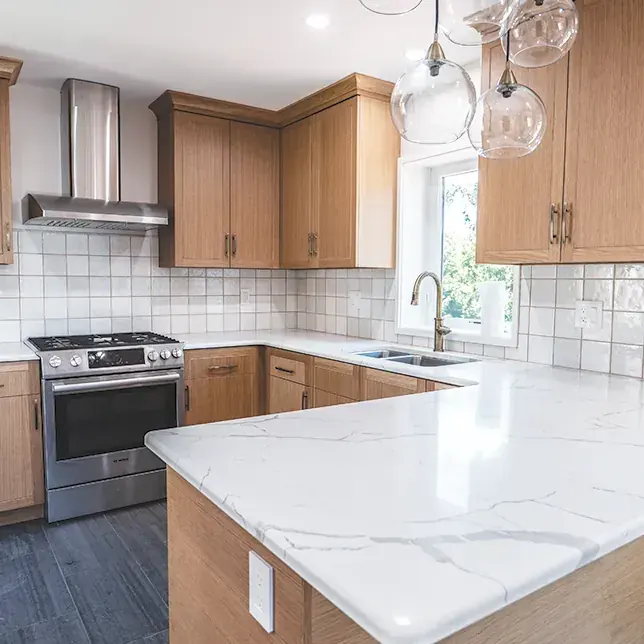
For most kitchens, hard maple is the best all-around wood for custom cabinets: it takes paint cleanly, holds fine profile detail, and machines without tearout. The finish you are planning changes that answer. If you want a stained cabinet that shows grain, white oak or cherry will outperform maple every time.
This article is part of our custom cabinets guide.
In our Marlboro shop, we build with four species most of the time: hard maple, white oak, cherry, and walnut. Every one of them is a legitimate choice. The decision comes down to finish direction, grain preference, and budget.
Why Wood Species Matters More Than Most Homeowners Expect
Wood species affects four things that matter in a kitchen cabinet: hardness, grain pattern, how the wood moves with seasonal humidity, and how it accepts a finish. Get the species wrong for your finish plan and you will fight the material through the entire build.
Janka hardness is the standard industry measure for a wood’s resistance to denting and surface wear. The test measures the force needed to embed a steel ball halfway into the face of the board. Hard maple comes in at 1,450 lbf. White oak sits at 1,360 lbf. Cherry runs softer at 950 lbf and walnut at 1,010 lbf. In a kitchen that takes daily use at door edges and drawer faces, those numbers matter.
Grain character determines whether a stain reads rich or muddy. Open-grain species like white oak absorb stain unevenly unless you apply a grain filler first. Tight-grain species like maple read nearly flat under most stains, which is why we steer painted jobs toward maple and stained or natural-finish jobs toward white oak or cherry.
Wood movement is the variable most homeowners do not think about until a door panel cracks its finish in the first winter. All solid wood expands and contracts with seasonal humidity changes. Hard maple has moderate, predictable movement. Flat-sawn white oak moves more dramatically across the grain than rift or quartersawn cuts of the same species. When Amanda Barton designs cabinet door panels in Chief Architect, she accounts for expected seasonal movement based on species and cut direction. A solid-wood panel built without that calculation will fail.
For context on how species fits into the broader custom cabinet decision, see our complete guide to custom cabinets.
The Four Species We Build With Most
Hard Maple
Maple is our workhorse. It is the most consistent species we run through the shop: tight grain, predictable color, few defects in select grades, and a surface that sands flat and holds paint without grain bleeding through the finish coat. If a client comes in wanting bright white painted cabinets with crisp profiles, we are starting with hard maple.
Maple’s limitation is that it is unremarkable under stain. The tight grain does not show the character that white oak or cherry brings, and it can read flat or washed-out unless you go very dark. We still build stained maple when clients insist, but white oak is a better call when visible grain is the goal. For a head-to-head on that specific choice, see our comparison of white oak vs. maple vs. cherry cabinets.
White Oak
White oak has become the dominant species in high-end kitchen work right now, and the reason is ray fleck. The medullary ray pattern visible in rift and quartersawn cuts gives white oak a visual depth and texture that no other domestic species matches. When clients bring in inspiration photos of natural-finish wood kitchens, most of what they are pointing at is white oak.
White oak also takes water-based finishes and penetrating oils well, which matters if a client wants a lower-VOC shop finish. The open grain requires sharp tooling to avoid tearout, and a grain filler pass before staining is standard if you want even color. The extra steps are worth it for the finished result. We go deeper on this species at white oak vs. maple vs. cherry cabinets.
Cherry
Cherry is not as popular as it was in the 1990s and early 2000s, but it is still a legitimate choice for the right kitchen. What cherry does that no other species matches: it deepens and richens in color over time as UV exposure transforms the wood. A cherry kitchen looks noticeably different at five years than it does at install day. The reddish-brown shifts toward a deeper amber. Some clients love that long-term evolution. Others do not want to think about it.
We use cherry on stained or natural-finish jobs only. Painting over cherry wastes the species and costs more than hard maple for the same painted result. Cherry is also the softest of our four primary species, so it is better suited to kitchens with lighter traffic or clients who understand the tradeoff between visual appeal and surface hardness. The full three-way comparison lives at white oak vs. maple vs. cherry cabinets.
Walnut
Walnut is a premium species. It runs at a higher material cost per board foot than maple or white oak, and the grain is the most visually distinctive of any domestic hardwood. We typically finish walnut with a clear or lightly tinted waterborne topcoat to protect the surface while letting the natural color and figure show through. Applying a heavy stain to walnut defeats the purpose of specifying walnut in the first place.
Walnut works best in kitchens where the cabinetry is meant to be the focal point. It reads formal and rich. It does not suit every aesthetic, and it should not be the default choice when budget is a primary constraint. In the right space, built from solid lumber, a walnut kitchen is hard to match.
What About Alder, Hickory, and Paint-Grade Poplar?
We build with other species when the project calls for them. Alder is a softer domestic hardwood at 590 lbf Janka. It takes paint well and costs less than hard maple in some markets. We use it occasionally on painted jobs where budget is the primary constraint, but we are clear with clients that alder will not hold up at door edges and high-contact surfaces the way maple does.
Hickory is the hardest common domestic cabinet species at 1,820 lbf Janka. The dramatic grain contrast makes it polarizing. When clients specify hickory, we make sure they have seen a full door sample in person before we commit to it. A photo does not prepare you for how bold it reads across a full run of cabinetry.
Paint-grade poplar appears in cabinet boxes and face frames in some shops. We use it in specific structural applications, but we do not build painted poplar door faces. The grain can telegraph through paint over time in ways that hard maple simply will not.
Species Comparison at a Glance
| Species | Janka Hardness | Grain Character | Best Finish | Relative Cost | Timber’s Take |
|---|---|---|---|---|---|
| Hard Maple | 1,450 lbf | Tight, uniform | Painted | $ Moderate | Default for painted work. Best value for crisp profiles under paint. |
| White Oak | 1,360 lbf | Open grain; ray fleck in rift and quartersawn cuts | Natural or stained | $$ Moderate-High | Best all-around for natural-finish kitchens. Most requested species right now. |
| Cherry | 950 lbf | Fine, straight | Stained or natural | $$ Moderate-High | Only if the client wants the aging patina. Softer than maple or white oak. |
| Walnut | 1,010 lbf | Bold, figured | Natural or clear coat | $$$ Premium | Statement kitchens. Budget accordingly and do not stain it. |
| Alder | 590 lbf | Subtle, uniform | Painted | $ Budget-Moderate | Budget painted option. Softer than maple — client needs to know the tradeoff. |
| Hickory | 1,820 lbf | Bold, high-contrast | Stained | $$ Moderate-High | Specific rustic aesthetic. Always confirm with a full door sample first. |
Painted or Stained: The Finish Decision Comes First
The species question is actually the second question. The first is: are you painting or staining? That single answer narrows the species list faster than anything else. Painted cabinet — start with maple. Stained or natural finish — start with white oak, then decide whether you want the aging patina of cherry or the premium grain of walnut.
We cover the full painted versus stained decision at painted vs. stained cabinets. If you are weighing white oak, maple, and cherry against each other, the full three-way comparison is at white oak vs. maple vs. cherry cabinets. And if you want to understand how species fits into the full scope of a custom kitchen, start with our complete guide to custom cabinets.
Frequently Asked Questions
What is the best wood for kitchen cabinets?
Hard maple is the most versatile choice for kitchen cabinets. It takes paint cleanly, machines without tearout, and holds up to kitchen use at 1,450 lbf Janka. If you want a stained or natural-finish cabinet that shows grain character, white oak is the better starting point. The right answer depends on your finish direction more than any other single factor.
Is maple or white oak better for kitchen cabinets?
Maple is the better choice for painted cabinets. White oak is the better choice for stained or natural-finish cabinets. Both are hard domestic species with comparable Janka ratings: maple at 1,450 lbf, white oak at 1,360 lbf. The distinction is in grain character. Maple is tight and flat under finish. White oak has open grain and the distinctive ray fleck pattern in rift and quartersawn cuts that defines the look of most natural-finish kitchens right now.
What wood is best for painted kitchen cabinets?
Hard maple is the standard in custom cabinet shops for painted work. Its tight, consistent grain takes primer and paint without bleed-through, and sharp door profiles hold their edge. Alder is a softer and sometimes less expensive alternative, but it does not hold up as well at door edges and high-contact surfaces under daily use.
Is walnut a good choice for kitchen cabinets?
Walnut makes exceptional kitchen cabinets when the budget supports it. The material cost runs higher than maple or white oak, and the bold grain works best when it is treated as a feature. We finish walnut with a clear waterborne topcoat in most cases so the natural color comes through without a heavy stain obscuring it.
Does wood species affect how long kitchen cabinets last?
Species is a factor, but construction quality matters more. A maple cabinet built with mortise-and-tenon door frames and dovetail drawer boxes will outlast a walnut cabinet built with stapled construction. That said, harder species like maple and white oak will resist denting and surface wear better than softer woods like alder under the same daily kitchen use.
How Timber Can Help
In our Marlboro shop, we build custom cabinets in hard maple, white oak, cherry, walnut, and other species depending on the project. Every kitchen starts with Amanda Barton drawing the full design in Chief Architect 3D: species, finish, door style, and profile all modeled before a single board is cut. The same team that designs the kitchen builds it and installs it.
We match 19th-century profiles for historic homes, and we build custom kitchens from $75,000 to $200,000. If you are considering a kitchen remodel, the species decision is one of the first things we work through with every client. Getting it right before the build starts is easier than correcting it after the finish is on.
Serving Marlboro, New Paltz, Wallkill, and the Hudson Valley.
Jeff Wiegmann is a Licensed General Contractor and Co-Founder of Timber Design + Build. Our team designs, builds, and installs custom millwork from our Marlboro shop at 168 Mt. Zion Road. We’ve matched 19th-century profiles for historic homes and built kitchens from $75k to $200k — always with the same crew from design to install.